Episode 5
The Drowned Lobby
Maha woke to the sound of her home being unmade.
The drill had bitten into the wall beside the lift shaft at midnight and never really stopped — a low toothache grinding in the bones of Marina Heights, travelling up nine floors into the floorboards of flat 9B. In the kitchen, Dadi hummed an old film song while she made the morning chai, the way she had every morning of Maha's twenty-two years, as if a tune could hold a building together.
"Chai," Dadi said, setting the cup down, and her hand — spotted, steady — rested a moment on Maha's hair. "Drink. The walls can wait."
Maha closed her fingers around the warm cup and thought: this. This kitchen, this song, this woman's hands. This is what a demolition notice really means. Not a plot of land. A morning.
Downstairs, the lobby had become a work site. Two workmen in Vertex caps carried chunks of plaster out of flat G-2, trailing grey dust. Javed Anwar stood in the doorway with his ring of new keys, watching the drill the way a man watches a dog he has trained to bite.
"Thirty days," Tara said beside Maha, not looking up from her phone. "He's not renovating. He's mining."
The lobby lights fluttered — once, twice — and steadied. Everyone had stopped noticing the fluttering. That was the worst of it.
Then the brass bell dinged.
Once. Clear as a struck coin.
Nobody had touched the call button. The brass gate stood open, the car's interior light burning yellow, the floor-indicator needle resting on zero — patient, the way a held breath is patient.
Omar went very still. "The lift was not called."
Rafiq Chacha came down the stairs two at a time, which Maha had never seen a man of his age do. "Don't!" he shouted — at them, at the open doors, at the whole lobby. "Don't you step in there!"
"Rafiq Chacha —"
"It has never called itself before!" His hands shook on the gate. "Forty years I have oiled this gate, and it has never once opened uncalled. Something is pulling from the other side!"
The car's light flickered. The needle sank — past zero, lower than Maha had ever seen it sink, into a place the dial didn't name.
Maha stepped through the gate.
"Maha!" Omar grabbed for her — missed — and then, because he was Omar, he followed her in. Tara followed them both, already filming.
Rafiq's voice thinned behind the closing doors: "Eleven minutes — the bell —"
The car fell, and fell.
---
The doors opened on dark, and on the smell of the sea.
Water lay over the threshold, ankle-deep, black and cold. Maha's shoes went under with a soft, terrible sound. Their phone lights swung up across a lobby she knew the way she knew her own face — and didn't.
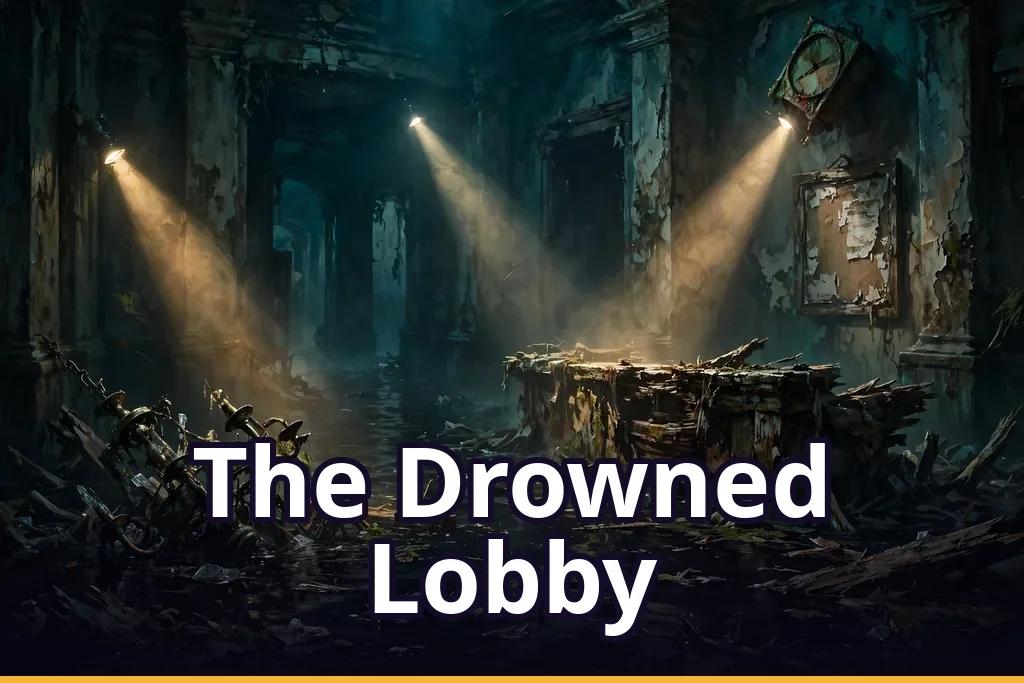
The chandelier lay drowned in a corner. The reception desk had rotted to a skeleton. The society notice board hung bloated and peeling, its pins rusted. Everything smelled of salt and abandonment. No voices. No footsteps. Dead silence, the kind that presses on the ears.
Above the dead reception desk, the lobby clock hung crooked, its face green with corrosion — and its minute hand was moving. Patient. Counting.
On the wall, a calendar page, swollen and half-slipped from its nail: DECEMBER 2049.
"Not the past," Tara whispered.
"The future," Omar said. "Rule five. One possible future. It — it can be changed. That's what Rafiq always says."
"Twenty-three years," Maha said quietly. "If the demolition happens —"
She didn't finish. She was already moving toward the stairwell.
"Maha, the lift — eleven minutes —"
"I need to see 9B." Her voice didn't sound like her own. "I need to see home."
The stairwell was a throat of darkness. On the ninth floor, the corridor stretched empty, doors torn from hinges, flats gutted to concrete, sea wind moving through broken windows like something looking for its rooms.
Flat 9B's door stood intact.
Maha's hand stopped an inch from the handle. On the door, a brass nameplate — polished, cared for — read:
A. QURESHI
And below it, carved into the wood, the cuts pale and fresh, the splinters still curled:
MAHA, YOU DIDN'T TRY.
Maha's fingers traced the letters. Her grandmother's flat. Her kitchen. The window where Dadi shelled peas and sang. Someone else's name. Someone else's —
"Maha." Omar's hand on her shoulder, steady. "It's not real yet. Rule five, remember? It can be changed. That's the whole point."
Tara was photographing everything, her hands shaking only a little. "Evidence," she said, like a prayer.
---
Back in the drowned lobby, pasted to the wall beside the dead clock, hung a notice in a plastic sleeve gone milky with water. Tara peeled it free with infinite care. Under their phone lights, the blurred official print:
MARINA HEIGHTS — DEMOLITION EXECUTED, 2026. SITE REDEVELOPED: VERTEX MARINA MALL (ABANDONED 2031)
"The mall died too," Omar said softly. "Five years. They flattened our home for five years of a mall."
A corner of the sodden notice tore off in Tara's fingers as she folded it. Small. No bigger than a coin. It slipped into her pocket before any of them quite decided to take it.
Then the brass bell, far away in the dark, gave its first warning ding.
They ran.
---
The doors sighed shut behind them and the needle climbed back past zero like nothing had ever happened — but Rafiq Chacha's face said everything had.
"Forty years," he whispered, his hands trembling on the gate. "Forty years I have oiled this gate and it never — beta, the lift is waking up."
"The drilling," Maha said. "G-2. The shaft wall —"
"Cracked it yesterday." Rafiq wouldn't meet her eyes. "I have been oiling more than the gate, children. I have been oiling the shaft guides, the cables, the bell — everything that keeps it asleep. And now —" He gestured helplessly at the fluttering lobby lights. "The fluctuations are multiplying. The wound is open."
Tara laid the sodden corner on the gate's ledge and photographed it beside her phone's picture of the full notice. The torn edge matched the missing corner exactly.
And then Omar, who had gone to the society notice board out of habit, said, very quietly: "Tara. Look."
Pinned to the board in the present-day lobby — Vertex's demolition notice, the one served thirty days ago — its lower corner was torn now, in the same jagged shape. As if the future's missing piece had found its twin.
A small ripple. A torn corner, mirrored across twenty-three years.
---
That evening, Maha told Dadi about the drilling.
She told it slant — the cracked shaft wall, the multiplying flickers, the men working through the night. She did not tell her about 2049. She did not tell her about the nameplate, or the carving. Some things a granddaughter does not say aloud to the woman who raised her.
Dadi went pale anyway. The chai cup rattled in its saucer.
"Not yet," Dadi whispered, to the window, to the sea. "I can't — not yet."
Maha took her grandmother's trembling hand in both of hers, the way Dadi had once held hers crossing busy roads, and said nothing at all.
---
At midnight, the drill stopped.
The silence woke Maha. She went to the lobby window with Tara and Omar already there, all three of them in nightclothes, watching.
In the dim yellow work-lights, the men were pulling loose plaster from the cracked shaft wall by hand now — and then one of them shouted, and they all stopped, and Javed Anwar pushed forward.
From a bricked-up niche in the shaft wall — a hollow no plan of the building had ever shown — a workman drew out, with infinite care, a brass key.
New. Unscratched. Still warm, as if someone had been holding it only a moment before.
In the dark above them, the old lift's brass bell gave one soft, satisfied ding.
---
Someone else had been riding.