Episode 6
The Night She Forgot
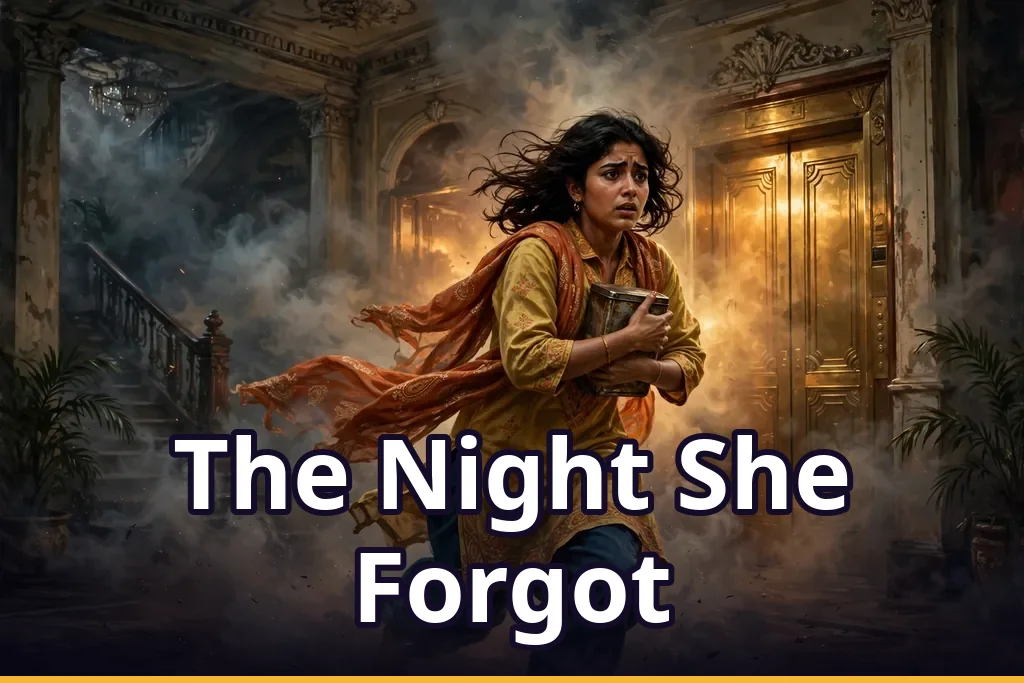
The morning after the drowned future, Maha sat at the kitchen table and watched her grandmother shell peas into a steel bowl, one soft tick at a time, and felt her heart break in a quiet, orderly way.
Dadi was humming — the same old film song she had hummed at this table for all of Maha's twenty-two years. The same sunlight. The same chipped blue cup of chai at Maha's elbow. And all of it, Maha now knew, had an expiry date stamped on it in someone else's handwriting: thirty days, and then the drills, and then the water, and then a stranger's name on this very door.
She had not told Dadi about the carving. MAHA, YOU DIDN'T TRY. She had carried those four words home from 2049 like a stone in her pocket, and all night they had burned there.
"Beta," Dadi said, without looking up, "you are staring at me the way people stare at a photograph they are afraid of losing."
Maha set her cup down. "Dadi. I have to tell you something, and I need you to believe all of it, even the impossible part."
So she told her. Not slant, not careful — the whole of it this time. The flooded lobby. The calendar page. The nameplate on flat 9B: A. QURESHI. And underneath it, carved fresh into the wood, the accusation.
Dadi's hands went still over the bowl. A pea rolled off the table and ticked across the floor, and neither of them picked it up.
"Then sit down properly, beta," Dadi said at last, in a voice Maha had never heard from her — low, and steady, and very old. "If the future is accusing you, the past owes you an answer. And I have owed you one for forty-one years."
---
"In 1985 I was thirty-three," Dadi said, "and I was on night duty at the reception desk, the way I had been since the hotel opened. The fire began after midnight, in the kitchen store at the back. It came up the back stairs like an animal looking for air."
Maha had heard the story of the 1985 fire all her life — everyone in Marina Heights had. What she had never heard was this part.
"Mr. D'Mello's tin box was in the office safe," Dadi said. "The box with the cooperative deed. The safe would have baked in the heat and no one would have opened it for days, so I took the box out. I carried it through the smoke with my dupatta over my face, and I hid it where the fire could not follow and no stranger would think to look."
"Where, Dadi?" Maha whispered.
Dadi looked at her hands. "That is the thing, beta. The next morning, when the fire was out and the police had gone, I went to fetch it — and the place was gone from my mind. Not faded. Gone. As if someone had opened my head like a book and torn out one page. I searched for weeks. Every cupboard, every panel, every store room. I told no one. Who would believe that the woman who remembered every guest's name had forgotten the one thing that mattered? So I carried it quietly, all these years, and told myself I was simply growing old and careless."
Maha took her grandmother's hands in both of hers. "Dadi, listen to me. Rule three. Every change made in the past ripples. That night you moved the deed — you changed where it was meant to be. And the ripple took its price. It took your memory of where you put it."
Downstairs, when they told him, Rafiq Chacha nodded slowly, his oil-can still in his hand. "Forty years I have watched the lift take its prices, beta. A shop's name. A song nobody sings anymore. Sometimes a memory. The lift is fair in its cruel way — it never takes more than the change is worth. And a deed, beta — a deed is worth a memory."
"There is one more thing," Dadi said, and her voice dropped lower still. "Mr. D'Mello gave me charge of that box himself, on the hotel's first night in 1972. He said, 'Sakeena, this box is not for the courts. It is for whoever loves this house enough to look for it twice.' And inside it, beside the deed, he placed a letter — sealed, addressed to the people who would live here after him. I never read it. It was not mine to read."
Omar let out a slow breath. "So the deed is still in this building. And so is D'Mello's letter. And the only person who ever knew where is standing right here — with the map torn out of her."
---
At noon the lobby lights fluttered — once, twice — and the brass bell gave its small, polite ding.
They were in the lift before Rafiq could finish saying their names, called from the lobby the way the rules demand, and the needle sank to zero and the doors opened on smoke.
1985. The alarm was screaming. The lobby was full of grey, rolling smoke, and through it came a young woman running, a tin box clutched to her chest, her dupatta over her face, her hair coming loose — Sakeena, thirty-three, terrified and brave in the same breath.
"Dadi!" Maha cried out before she could stop herself.
The young woman turned toward the sound, eyes wide in the smoke — and then the lobby clock's minute hand completed its round, and the brass bell dinged, and the doors sighed shut on the sight of her disappearing toward the service stairwell, the box still in her arms.
They had not seen where she hid it. They had seen something better, and something worse: it was real. She had really done it. And she had been so young, and so alone in that smoke, carrying the whole building's future in a tin box.
Back in the present, in the kitchen, Dadi held Maha's hand and closed her eyes. "I remember one thing, beta," she whispered, "and I have never told it to anyone because I thought it was a dream. I remember the sound of water. Wherever I hid it, I could hear the sea through the wall."
---
That evening, the lobby lights fluttered again, and the brass bell dinged — although no one had touched the call button.
They ran downstairs. The brass gate stood open, and out of the lift stepped Javed Anwar, dust on his shoes, holding the warm brass key they had watched him pull from the shaft wall the night before.
He smiled at them, the way a man smiles when he knows something you do not.
"Mr. Qureshi sends his regards," he said. "He is coming to see the past for himself."