Episode 4
The Fire Everyone Misremembers
Maha didn't sleep that night. Every time she closed her eyes she saw it again: Javed Anwar's smile, the Vertex logo glowing on his phone, the society manager nodding like a man being paid to nod.
By morning, Tara had answers — or the closest thing to them.
"He's not just visiting," Tara said, sliding her phone across Maha's bedroom carpet. The society's transfer register, photographed crookedly by the manager's assistant, who owed Tara a favour. "Javed Anwar. Application for tenancy. Flat G-2. Ground floor."
Omar, cross-legged beside her, went pale. "G-2? That's the flat that shares a wall with the lift shaft."
"The one nearest the lift," Maha said quietly. "Baz told him to take the flat nearest the lift."
"Thirty days are enough to buy the past," Tara quoted, and none of them laughed.
It was Rafiq Chacha who found them in the lobby that afternoon, standing too close to the brass gate with their heads together. The old liftman oiled the gate slowly, not looking at them.
"You're thinking of riding again," he said.
"We need to find the deed before he does," Maha said.
Rafiq's hand stopped. "Beta. The lift is not a weapon. It is a memory. And memories —" he tapped the gate, and it rang faintly, "— bite when you grab them."
"We'll follow the rules," Omar said. "Called from the lobby. Back before the bell. Small steps."
Rafiq studied the three of them for a long moment. "The fire year," he said at last, so quietly Maha almost missed it. "If you're going to chase paper, chase 1985. That was the year everyone stopped looking."
"The fire," Maha breathed. Dadi's old story: the night Hotel Marina's records office burned, and the founding papers with it. "Dadi always said the fire took everything."
"Everyone says that," Rafiq said. "That's what makes it worth checking."
They waited by the gate until evening, when the load-shedding schedule bit and the lobby lights fluttered — once, twice —
and the floor-indicator needle sank past zero.
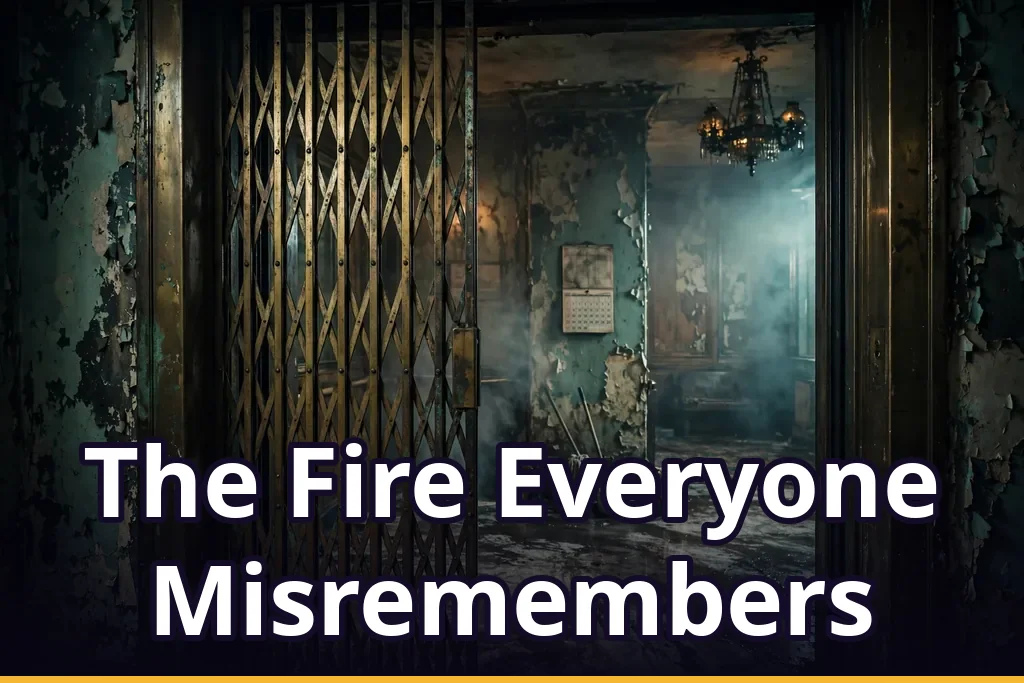
The doors opened on smoke.
Not thick smoke — the ghost of it, days old, soaked into carpet and curtains. The lobby beyond the gate was the same room and not: the chandelier at half its crystals, the marble dull under a film of soot, men with buckets crossing a floor covered in wet black footprints. A wall calendar, its edges curled brown: MARCH 1985.
"We're in the after," Tara whispered. "The fire already happened."
A clerk hurried past with a stack of singed ledgers. "Records room's a shell," he told another. "Forty years of the hotel's heart — gone. Locked from the outside, they say. Nobody asks anymore."
Locked from the outside. Maha filed the words away like a sketch line.
"Eleven minutes," Omar muttered, watching the lobby clock. "Let's find the deed before the bell finds us."
They didn't have to search far. Across the smoky lobby, directing two porters with the calm of a general, stood a woman of thirty-three in a plain sari, her hair pulled back, soot on one cheek — and Maha's breath stopped, because she knew that face the way she knew her own hands.
Young Sakeena.
Maha took a step forward — "Dadi —"
The lift behind them gave a low, warning hum, and the brass gate trembled on its track. Rafiq's voice in her head: the lift refuses. Family is close enough.
Maha froze. The hum died. Across the lobby, young Sakeena glanced up — her eyes met Maha's for half a second, stranger to stranger — and then she turned, picked up a canvas bag from behind the reception desk, and slipped toward the back corridor.
"She's carrying something," Tara said.
They followed at a distance, keeping to the shadows of the corridor. At the laundry-room door, Sakeena stopped. She looked both ways. Then, from the canvas bag, she drew out a tin box — its lid scorched black on one corner, its clasp bent.
Maha's fingers closed on Omar's sleeve. The box. D'Mello's box — the one from the photograph, the one that was supposed to have burned.
Sakeena held it a moment, the way you hold something that has survived when it shouldn't have. Her lips moved. Maha, straining, caught the words:
"Not the fire's. Never the fire's."
A door banged somewhere. Sakeena startled, shoved the box back into the bag, and hurried deeper into the corridor — toward the offices, toward somewhere only she knew.
Maha started after her — and the brass bell, far down the corridor, gave its first warning ding.
"No no no —" Omar grabbed her arm. "Maha, the bell!"
"She's hiding it right now — we have to see where —"
"Eleven minutes, Maha! If we miss the doors we wait for the next fluctuation — whenever that is!"
Tara was already running. Maha took one last look at the corridor swallowing her grandmother's young shadow — and ran.
They tumbled through the gate as the doors sighed shut behind them, the needle climbing back past zero like nothing had ever happened. In Maha's pocket, something small and hard knocked against her keys: a singed matchbox from the lobby floor, Hotel Marina's faded crest still legible on one side.
Small things slip through, Rafiq had said.
Back in the present lobby, Tara stopped dead, staring at the street.
"What?" Omar asked.
"The dhaba sign." Tara's voice was thin. "It always said Cafe Marina. Since we were kids. Look at it now."
Painted in fresh white, the sign read: MARINA CAFE.
A small ripple. A shop's name, flipped like a coin. Maha felt the floor tilt under her — proof, if they'd needed it, that what they'd touched in 1985 had touched them back.
---
Evening. Floor 9. Dadi's radio played an old film song while she shelled peas into a steel bowl, the picture of every ordinary evening Maha had ever known.
Maha set the singed matchbox on the table between them.
Dadi's hands stopped.
"Dadi," Maha said gently, "the papers didn't burn in the 1985 fire."
Silence. The radio sang on.
"You were there. You picked up the tin box — the one with the hotel's founding papers. Everyone thinks they burned." Maha's voice shook. "But you saved them, Dadi. That night, you hid the box. Where did you put it?"
Dadi Sakeena looked at the matchbox for a long time. Then she reached out — slowly, as if the air were water — and turned the radio's knob. The song died mid-word.
"I don't remember, Maha," she whispered.
The peas sat forgotten in the bowl. Dadi's hand, resting on the table, trembled — the hand that had once, forty years ago, carried a scorched tin box through a smoking corridor.
"That night," Dadi said, to the window, to the sea, "that night took something from me too."
She didn't say another word. She didn't have to. For the first time in her life, Maha looked at her grandmother and saw not Dadi, but the young woman in the smoke — carrying the weight of a whole building's memory alone, for forty years, in silence.
Maha covered the trembling hand with her own, and said nothing at all.
---
Morning came with a moving truck.
Maha found Tara and Omar already at the lobby window, watching workmen carry drilling rigs and toolboxes into flat G-2 — the flat that shared a wall with the lift shaft. Javed Anwar stood in the doorway with a ring of new keys, directing them like a general.
Vertex caps. Vertex crates. A stencil on one crate, half-covered: VERTEX DEVELOPERS.
"He's in," Tara said. "Thirty days, Maha. He's going to drill straight into the lift's bones."
As if he'd heard her, Javed looked up at the window — and smiled the same smile.
Then a drill bit into the wall beside the lift, the lobby lights fluttered —
and the old lift's brass bell dinged, once, though nobody had called it.