Episode 11
The Letter That Saved a Home
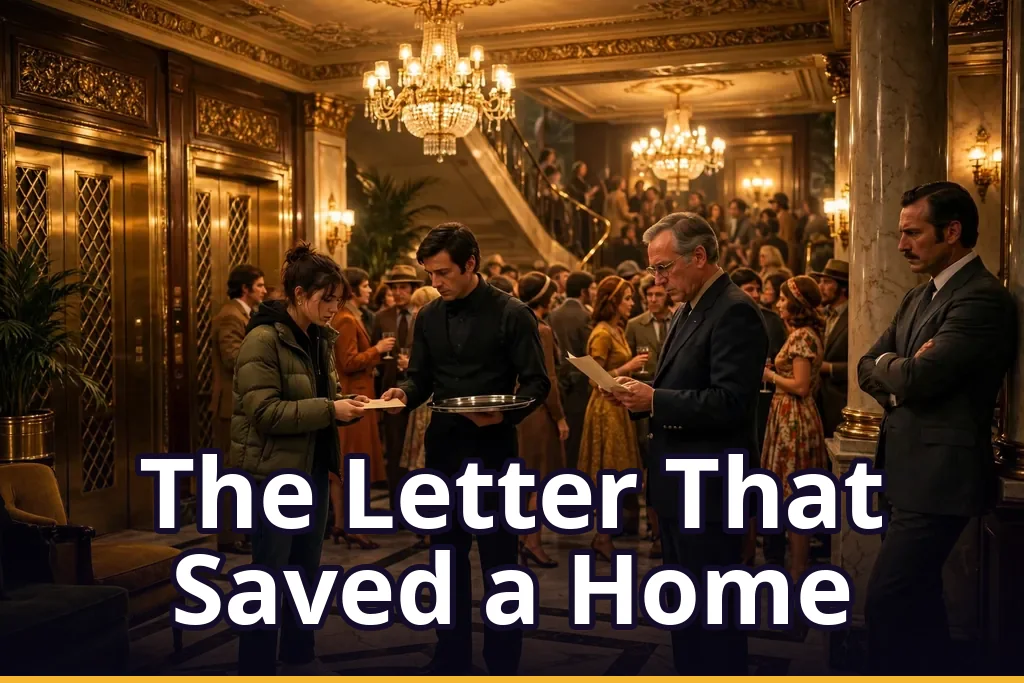
The generator on Marina Heights' roof roared, and the lobby lights fluttered — once, twice, three times. Maha stood with her hand on the old lift's brass gate, listening as if to a heartbeat.
"Not yet," Rafiq Chacha said, eyes on the lobby clock. "The lift only opens when the power truly trembles, and only when called from this lobby. The rule bends for no one — not even a man with a generator."
"Baz is already there," Omar said. He was breathing hard, his delivery jacket still damp with sweat. "He is walking through 1972 right now, toward Mr. D'Mello, with a contract in his hand. While we stand here, he is buying our home before it ever belonged to us."
"Then we go the moment the tremble comes," Tara said. She had a small notepad in her hand — the one she carried on every trip, because small things sometimes slipped through and big things never did. "And we stop him without breaking a single rule. Because if we break the rules, we lose more than the building."
Rafiq Chacha nodded slowly. "Remember the clock. When the minute hand finishes one round, the brass bell dings and the doors close. Eleven minutes. Miss the doors, and you wait in 1972 until the next tremble."
Maha glanced toward the stairs, toward the flat where Dadi Sakeena slept, seventy-two and perhaps dreaming of the night she was twenty. "And my grandmother?" she asked quietly. "She is down there tonight. At the reception desk."
"Do not go near her," Rafiq said, his voice low and serious. "You cannot meet your own family self so closely. The lift knows. It refuses — it shudders, it will not open — if your other self is near. Keep your distance from young Sakeena. Promise me."
"I promise," Maha said — though her heart was already running ahead, down into that golden year.
Then the lights went out for one full second of darkness and came back humming. The whole building seemed to shiver, and deep in the walls the old lift gave a low ding.
"Now!" Rafiq cried. "Call it from the lobby — now!"
Omar pressed the call button. The brass gate slid open as if it had been waiting all its life. The three friends stepped inside, and the lift did not go up or down. It went — elsewhere. The numbers flickered past floors that did not exist, and then the gate opened on music.
Opening night of the Hotel Marina, 1972.
The lobby was gold and white and full of people, a band playing near the staircase, waiters carrying trays through a laughing crowd. Above the reception desk, a banner read: HOTEL MARINA — OPENING NIGHT. And behind the desk, in a neat dark uniform, stood a young woman of twenty with Maha's own eyes, smiling as she handed a guest a key.
Young Sakeena. Maha's grandmother, young.
Maha's feet moved before her mind could stop them. One step. Two steps toward the desk — toward the grandmother she had never seen young.
And the lift behind her shuddered.
It was not a sound but a feeling, deep in the floor, as if the whole building had flinched. The brass gate rattled; the lights above the lift dimmed and buzzed. Maha froze, one foot still in the air, and the shuddering stopped the moment she stepped back.
"Maha!" Tara hissed, grabbing her arm. "The lift is warning you. That is rule four. You cannot go near her. It refuses."
Maha swallowed hard. "I know. I will not talk to her. But I can still act."
Across the lobby, near the little stage, stood Mr. Harold D'Mello — tall, silver-haired, in a dark suit, smiling the smile of a man who had built something with his own hands. Moving toward him through the crowd, smooth and unhurried, came Baz Qureshi, a slim folder under his arm. A contract: small enough to slip through time, dangerous enough to steal a future.
"He is going to offer him money for the land," Omar said. "Before the cooperative, before any of us. If D'Mello signs tonight, Marina Heights is never ours."
"Then we need D'Mello to refuse," Tara said. "And we cannot tell him ourselves — Baz would hear, and a scene would ruin everything. So we warn him the quiet way."
Maha understood at once. She pulled out her little notepad, tore out a page, and, leaning against a marble pillar where no one could see, wrote fast:
"Dear Mr. D'Mello, a stranger who loves this house begs you: do not sell this land tonight. The man coming toward you does not want a hotel; he wants the ground under it, and will one day pull this house down. Keep it for the people who will live in it and call it home. Hide your deed where only a resident's love can find it. — A Friend of This House."
She folded the letter small — small things slip through — and looked for a waiter. A boy of about sixteen came past with a tray of glasses. Maha smiled and pressed the folded paper into his hand with a coin. "For Mr. D'Mello," she whispered. "Private. Only into his hand."
The boy nodded and slipped away.
"Now we need time," Omar said, straightening his jacket like a man about to do something brave and foolish. "I will slow Baz down. Tara, watch the clock. Maha — watch D'Mello."
Before Tara could argue, Omar stepped into the crowd and — quite by accident, of course — collided with a waiter near the stage. Glasses rattled, a guest laughed, and Baz, three steps from D'Mello, turned at the noise and had to step around the spill. It bought them less than a minute. On a night like this, that was everything.
Because the boy had reached D'Mello. Maha watched the old founder take the folded paper, open it, and read. His smile faded. His eyes moved across the crowd and rested, for one heartbeat, on the marble pillar where Maha stood half-hidden.
He nodded once, slightly, as if to a stranger who had told him the truth.
Then Baz was there, hand outstretched, folder open, voice smooth as polished stone. "Mr. D'Mello, a wonderful night. I represent investors who would pay you a fortune for this land tonight. Sign here, and you will never worry about this building again."
The crowd near the stage went quiet. Maha held her breath. Tara gripped the pillar. Omar, mopping at the spill with a napkin, did not dare look up.
D'Mello looked at the contract, then at the letter in his other hand, then around his beautiful lobby — and closed the folder gently.
"No," he said, clear and calm. "This house is not for sale. Not tonight. Not ever, to a man who wants the ground and not the home. I built this place for people, Mr. Qureshi. People will live here, and people will keep it. Good night."
Baz's smile froze. "You will regret —" he began.
"I do not think so," D'Mello said, and turned away. He walked quickly toward a small door beside the reception desk that Maha had never noticed. In his hand she could see it now: a small tin box, the deed box from the old photograph. He was going to re-hide it.
"Follow him — quietly!" Tara whispered. "We have to see where he puts it!"
The three friends moved through the crowd, keeping their distance from the reception desk and from young Sakeena. D'Mello reached the small door, glanced once over his shoulder, and then —
Not yet. But above the old lift, the brass bell gave its first warning tremble, a soft, thin sound, like a glass about to sing.
"The minute hand!" Tara gasped, looking up at the clock. "It is almost round! We have less than a minute!"
D'Mello pushed the small door open. Beyond it, Maha glimpsed a narrow room — a dark iron safe set into the wall — and D'Mello sliding the tin box inside, behind something, somewhere only —
And then Baz turned.
He turned from the stage, his eyes swept the crowd and stopped — stopped dead — on Maha's face. He knew that face; he had seen it in the present, in the lobby of the building he wanted to flatten. His mouth opened, his hand came up, pointing —
And the brass bell dinged.
Across the lobby, the lift doors began to close.
"Run!" Omar shouted. "Run for the doors!"
Maha ran — but her eyes were on the small door, on the safe she had only half-seen, on the hiding place she only half-knew. Behind her, through the music and the crowd, came Baz's voice, sharp as a slap:
"You! Stop her!"
The doors were closing. And the deed was hidden somewhere new, somewhere only a resident's love could find, and Maha did not yet know where.