Episode 12
The Door That Love Opened
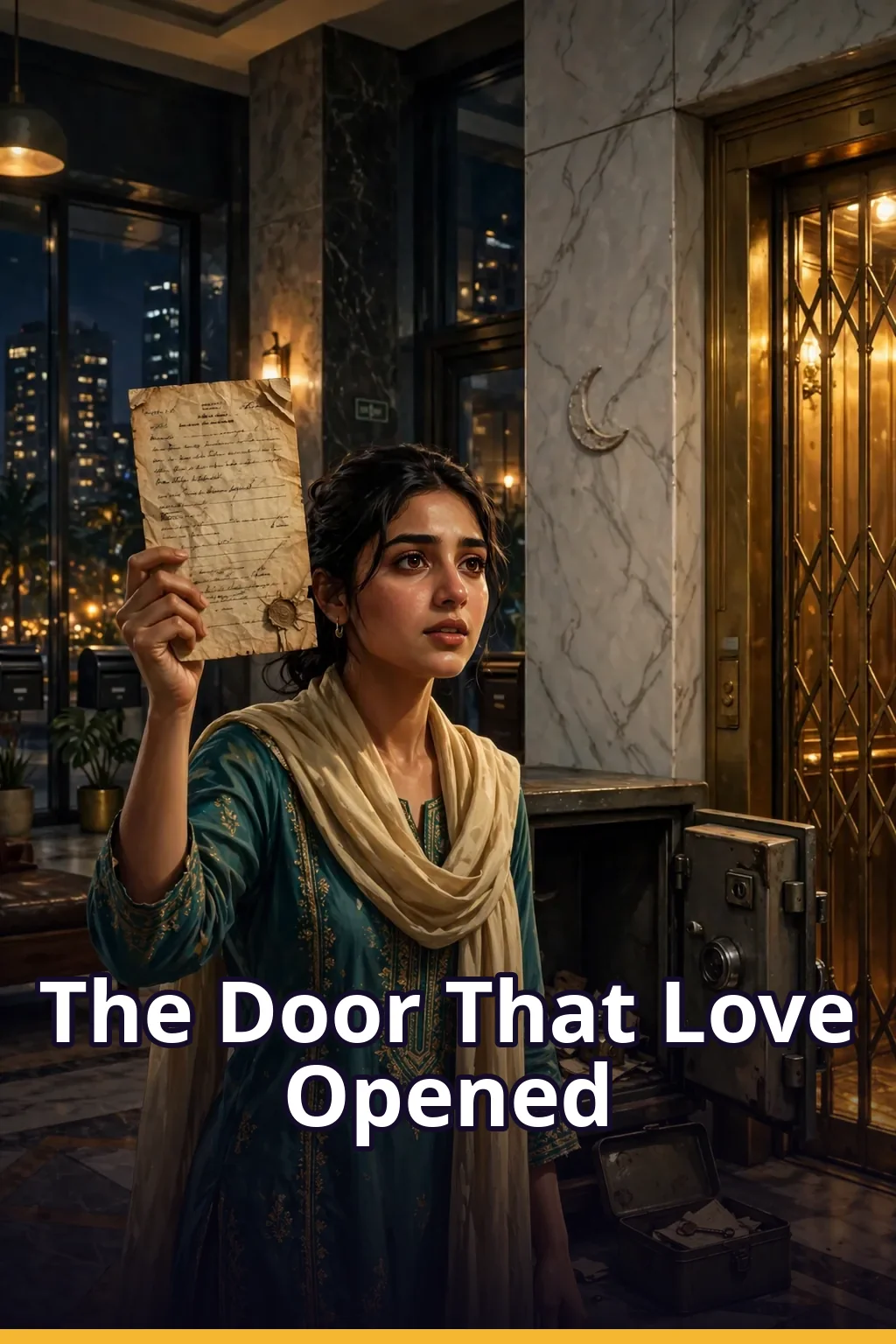
The bell was still ringing when Maha ran.
It was a thin, bright sound, and it seemed to come from everywhere at once — from the brass bell above the lift, from the chandeliers, from the floor under her feet. Across the golden lobby of the Hotel Marina, 1972, the lift doors were closing. Behind her, Baz Qureshi was shouting, "You! Stop her!"
A waiter carrying a tray stepped neatly into his path — not by accident, Maha thought later, but because in a crowded room a shouting man is everyone's problem. Baz shoved past him. A glass fell. Someone laughed. And in that half-second of noise and confusion, Omar caught Maha's arm and threw her toward the lift, and Tara, already inside, caught her other hand and pulled.
Maha fell through the closing doors and landed hard on the lift floor. Omar tumbled in after her. The brass gate rattled shut — and through the narrowing gap, Maha saw Baz's hand reach for it, too late, and his face, white with fury, disappear behind the brass.
Then the numbers above the gate flickered. The lift did not go up or down. It went — home.
The gate opened on the present-day lobby of Marina Heights. The generator on the roof was still roaring. The lights were still fluttering. And Rafiq Chacha was standing exactly where they had left him, one hand resting on the brass gate, calm as a man who had waited forty years for a door to open.
"Baz?" Omar gasped, still on the floor. "Where is Baz?"
"The bell decides," Rafiq said. "He missed the doors. He waits in 1972 until the next tremble comes — whenever that is."
Maha sat up, her heart hammering. "He saw my face. He knows now. He knows it was us."
"Let him know," Tara said, pulling her up. "Knowing is not owning. And we saw something too." She turned to Rafiq. "Chacha, in 1972, D'Mello carried the tin box through a small door beside the reception desk. There was an iron safe set into the wall. That safe — it is still here, isn't it? Behind the marble panel?"
Rafiq Chacha went very still. "The safe," he said slowly. "After the fire of 1985, they rebuilt that wall, and the safe was bricked in behind it. The marble panel went up over it — the panel with the crescent mark." He looked at Maha. "The mason carved a little crescent moon into the stone. D'Mello's mark. He said the panel would open only for someone who loved this house enough to look closely."
"Then we open it," Maha said. "Not by breaking it. In front of everyone. With witnesses."
"First," Rafiq said, "fetch your Dadi. This is her memory too."
Maha ran up the stairs two at a time — the lift was resting, the fluctuation spent — and came back with Dadi Sakeena, wrapped in her shawl, her eyes wide. The whole lobby seemed to hold its breath as the old woman walked to the marble panel and laid her palm flat against the stone.
"The crescent," Dadi whispered. "I remember the crescent. After the fire, I carried the tin box back to the safe myself. The smoke, the box warm in my hands — and then the builders put up the wall, and the years went over it, and I forgot. But the crescent I never forgot." Her voice broke. "I hid our home, and then I forgot where I had put it. Forgive me."
"There is nothing to forgive," Maha said, and her own voice broke too. "You kept it safe. That is what matters. Now help me open it."
By then the lobby was filling. Word had travelled up the tower the way news always did in Marina Heights — flat to flat, floor to floor — and the residents were coming down in their slippers and shawls: the cooperative chairman, the families from every floor, old Mrs. D'Souza with her walking stick. Tara stood by the panel with her phone, recording everything, because evidence mattered and because this moment deserved a witness.
Maha knelt before the panel and ran her fingers beneath the crescent mark. There — a tiny keyhole, cut into the stone so neatly that fifty years of eyes had passed over it. Her hand went to her pocket, to the small brass key that had slipped back with her on that first storm night, the key she had carried ever since. It fitted. It turned.
The marble panel swung open on hidden hinges — not broken, not forced, opened — and behind it, set into the wall, stood the old iron safe.
A gasp went around the lobby. The brass key turned again, in the safe this time — it had always been the hotel's master key — and the safe door swung open.
Inside was the tin box.
Dadi Sakeena lifted it out with both hands, as gently as a newborn, and set it on the reception desk — the same desk where she had stood at twenty, handing guests their keys. Maha opened the lid.
Inside lay the deed: the founding deed of the Marina Heights Residents' Cooperative, signed by Harold D'Mello in 1972, giving the land and the building to the people who would live in it and call it home. And beneath the deed, a letter, in D'Mello's own hand.
Dadi read it aloud, her voice steady now, carrying across the silent lobby.
"To whoever finds this — tonight a stranger warned me that a man would one day come for the ground beneath this house, and not for the home upon it. I believed her. So I am hiding this deed where only a resident's love can find it. This house was built for people. Keep it for people. — Harold D'Mello."
The lobby erupted. People were crying and laughing and hugging each other, and old Mrs. D'Souza was banging her walking stick on the floor for joy. The chairman took the deed in both hands and held it up like a trophy. "The land was never Vertex's to buy," he declared. "Marina Heights belongs to its residents — since 1972, and forever. The demolition notice is void."
And Maha, who had carried the heritage-listing application in her sketchbook for weeks, waiting for proof, laid it on the desk beside the deed. "Then let us make it official," she said. "Marina Heights is not a plot. It is history. It is home."
That was when the lights flickered.
The lift dinged. The brass gate slid open — and Baz Qureshi stepped out, his suit crumpled, his tie loose, his face dark with fury from a night spent waiting in 1972 for the next tremble. He opened his mouth to threaten, to demand, to take —
And stopped dead.
The whole cooperative stood before him. The deed was held high. Tara's phone was recording. The chairman smiled, the calm smile of a man holding every card.
"Mr. Qureshi," he said. "You are trespassing in our lobby. The demolition is cancelled. Your claim is finished. Good night."
Baz looked from face to face — at Maha, at Omar, at Rafiq Chacha, at Dadi Sakeena holding her granddaughter's hand — and for the first time, he had nothing to say. He turned, walked out through the front doors of Marina Heights, and did not look back.
In the quiet that followed, Omar put his arm around his father. "Forty years, Abbu," he said. "Forty years of keeping this lift's secret. And your name is on the building register, where it belongs. It never left."
Rafiq Chacha closed his eyes, and for a moment the liftman looked like a man who had finally been allowed to rest. "The lift keeps its own time," he said. "And tonight, it kept ours."
Dadi held the deed to her chest, and Maha opened her sketchbook and began to draw the lobby — the marble panel standing open, the tin box, the faces of her neighbours — because buildings are people's lives, not plots, and this one was safe now. The flooded, empty future she had once glimpsed would never come. This was the future instead: a lobby full of people who belonged to each other.
That evening, in their flat on Floor 9, Maha and Dadi sat with two cups of chai, watching the lights of Karachi glitter below. The power flickered once, softly — and out in the corridor, the old lift gave a gentle ding.
Maha went to the door.
An old man stood there, in a 1972 hotel uniform, silver-haired, smiling the smile of a man who had built something with his own hands. He looked past Maha, at Dadi Sakeena, and his eyes lit up.
"Reception, madam?" he said.
Dadi's cup stilled in her hand. She rose slowly to her feet, her eyes filling with tears, and whispered his name.
"Harold..."