Episode 10
The Race on Opening Night
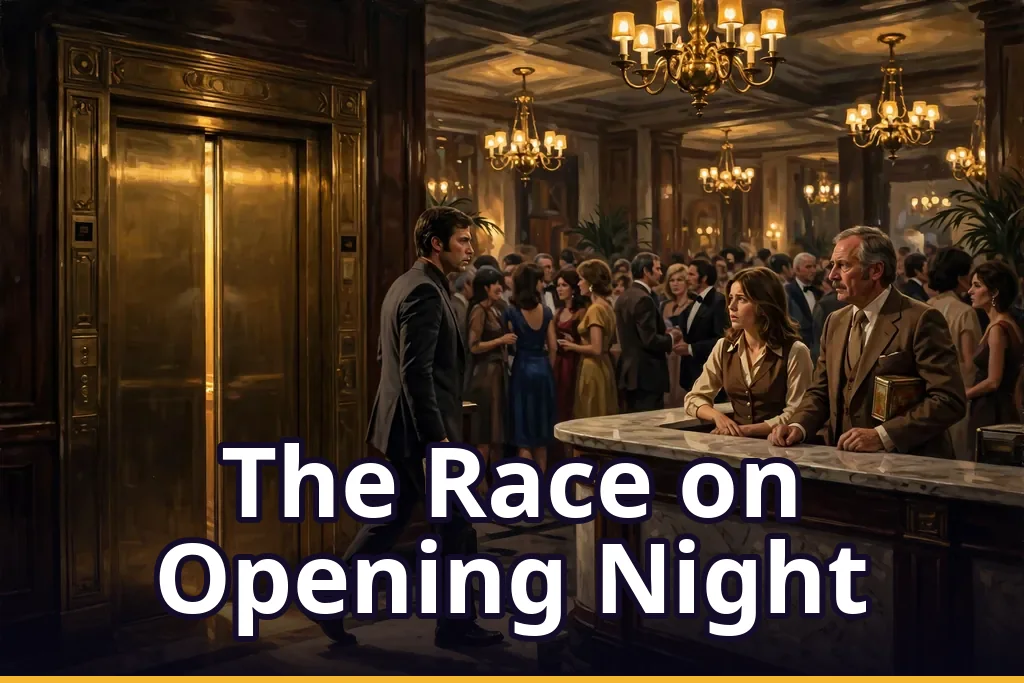
Maha woke to the sound of her home being stolen one hum at a time.
It was past midnight. Below Marina Heights, a generator throbbed like a second, angry heart. The lights in her flat fluttered — dim, bright, dim — and Dadi Sakeena's hand found Maha's in the dark.
"He is down there," Dadi whispered. "Baz Qureshi. He has not come to drill, beti. He has come to take the lift."
Maha's throat closed. The safe behind the marble panel held D'Mello's tin box — the deed that could save every family in the tower. If Qureshi reached 1972 first, daylight would never come.
"Stay with the door locked," Maha said, kissing Dadi's forehead. "If the lights go wild, do not call the lift."
"I promise," Dadi said. "But hurry. A man like that does not knock twice."
---
The lobby smelled of diesel. Qureshi stood beside the old elevator in a suit that had never seen a building site, watching his men wheel a yellow generator through the doors. Cables snaked across the marble. Rafiq Chacha stood in front of the brass gate, arms folded, his cloth still in his hand.
"The lift is not a door you can kick, sahib," Rafiq said. "It opens when the power trembles. It does not open for a man."
"Then we will make the power tremble," Qureshi said. "Start it."
The generator roared, and the tower shuddered. Lights surged white, then sank to orange. Tara ran down, phone recording. Omar came from the stairwell, pale.
"Abbu, step away," Omar said.
"A liftman does not step away from his lift," Rafiq said.
Qureshi pressed the lobby call button himself — Floor Zero came only to a lift called from the lobby. The gate slid open on golden light that did not belong to this year.
Qureshi picked up his leather briefcase, thick with contracts, and stepped forward.
The lift refused the briefcase. It struck something invisible and thudded back onto the marble, clasps bursting, papers spilling. Only what fit in a pocket had gone with him: one folded contract and a pen. Nothing large could be carried across. The rule had held, even for him.
He laughed, and stepped into the golden light alone. "Eleven minutes, gentlemen. Keep the generator running. I will be back with 1972 in my pocket."
---
"He knows about the bell," Rafiq said. "Someone has been telling him the rules. A visit lasts until the lobby clock's minute hand goes all the way round — about eleven minutes. When the bell dings, the doors close. Miss them, and you wait for the next tremble."
"Then we follow him," Maha said.
"Not on this tremble," Rafiq said. "The lift will not open twice on one. You wait for the next. Carry nothing large — only what fits in a pocket. You cannot meet yourselves, but none of you were alive in 1972. Your danger is different: whatever you change there ripples here. A small change, a small ripple. A big change, and someone is forgotten. Remember my name, beta. Remember it hard."
"I will, Abbu," Omar said.
Tara slipped her phone into her pocket. Maha kept only a pencil. Omar kept only his delivery cap, folded small. They waited by the call button while the generator rose and fell and Qureshi's eleven minutes burned away in another year.
"Now," Rafiq whispered, as the lights fluttered again. "Call it from the lobby. Quickly."
Maha pressed the button. The gate opened on the same golden light. The three of them stepped in together, and the tower let them go.
---
1972 arrived as music: chandeliers, a band, waiters with trays, the smell of jasmine. No dust, no drills. Maha's eyes filled — her home before it was tired.
And there, behind the reception desk, was a girl of twenty with Dadi's eyes. Young Sakeena, in the hotel uniform, smiled at a guest and counted keys with quick fingers. Maha took one helpless step toward her, and Tara's hand closed hard around her wrist.
"No," Tara breathed. "Not a word. She cannot know you. If you speak to her, you change everything she becomes — including the grandmother waiting upstairs. Look, but do not speak. That is the price of this floor."
Maha nodded.
"Clock," Tara said. "Three minutes gone. Qureshi has a head start. Find him."
Near the desk stood Qureshi's driver, trying to look like a guest, watching the desk and the office corridor by turns — the watcher, left to guard the desk while his master hunted. Omar tugged his cap low. "He watches the desk. So Qureshi is after the office. D'Mello's office. The box."
Down the corridor, a door stood open. Inside, a kind-faced man in a manager's suit — Mr. Harold D'Mello himself — lifted a small tin box from a drawer, turning it in his hands as if weighing a secret. Maha's heart hammered. The box. The real box, in the year it was hidden.
Then Qureshi stepped out of the crowd into the office doorway, the folded contract in his hand, smiling like a man who has found exactly what he came to buy.
---
"Five minutes gone," Tara whispered. "Slow him down without changing anything big. A small delay. A small ripple."
Omar snatched a tray from a passing waiter, turned, stumbled, and sent glasses chiming across the marble two steps from the office door. Champagne fountained. Guests gasped, then laughed. Qureshi jerked back, his shoe soaked, his smile gone for one furious second. It was only a spill — in the present, nothing more than a waiter's story. But it bought them seconds, and seconds were everything.
D'Mello, startled, stepped out with the tin box under his arm and walked toward the reception desk, toward young Sakeena. Maha understood with cold terror: if Qureshi reached D'Mello before the box was hidden, there would be no safe behind the marble, no deed, no home.
"Nine minutes," Tara said, voice tight. "The bell is coming."
Qureshi shook the waiter off and strode after D'Mello, contract raised like a flag. The driver pushed away from the desk to cut across the lobby. Three ways, one man, one box — a sprint through a celebration, while the crowd laughed, unaware that the building's whole future was running between them.
"The lift!" Omar grabbed Maha's sleeve. "Miss the bell and we wait here for hours. Abbu is alone with the generator men."
Maha looked once at D'Mello, and once at young Sakeena, who had looked up with a puzzled, polite smile at the stranger in the modern suit.
"We go," Maha said, hating it. "We cannot save the box by being stranded here. The bell decides."
They ran. The minute hand crawled toward the top. The lift gate stood open, golden and patient. Behind them, the driver shouted. Ahead, the brass bell gave its warning note.
They tumbled into the lift as the bell dinged. The gate began to close.
And Qureshi stopped. He stood in the middle of the 1972 lobby, halfway between the lift and D'Mello's office, the crowd parting around him. He looked at the closing gate. He looked at D'Mello, paused by the desk, tin box under his arm, watching the wet-shoed stranger with open curiosity. And Shahbaz Qureshi made his choice.
He stepped back.
"Tell Rafiq," he called through the narrowing gap, smiling, "that I have decided to stay for the rest of the party. There will be another tremble. And when your friends come back — if they come back — I will already have bought the ground they are standing on."
The gate closed. The golden light went out. The lift rose through darkness smelling of dust and diesel, and the three friends held on to each other and said nothing.
---
The present-day lobby was cold and loud with the generator. Rafiq waited at the gate, his face grey. The lobby clock showed eleven minutes had passed — here, and there.
"He stayed," Maha said, her voice shaking. "He is in 1972 right now, walking toward D'Mello, with a contract in his pocket and no one to stop him."
"He will wait for the next fluctuation," Rafiq said. "And we cannot follow until the power trembles again. That is the rule, even for him." He looked toward the stairs, toward the flat where Dadi waited behind a locked door. "Your Dadi is twenty years old tonight, down there in that year. And a man who buys buildings is walking toward her with a pen."
Above them, the generator coughed and roared louder. The lights fluttered — once, twice — and somewhere in the walls, the old lift gave a low, patient ding.
Maha looked at the gate. Omar looked at his father. Tara looked at the clock, where the minute hand had only just begun its next slow round.
The next tremble was coming. And none of them knew who would ride it next.