Episode 7
The Black Car and Locker Number 14
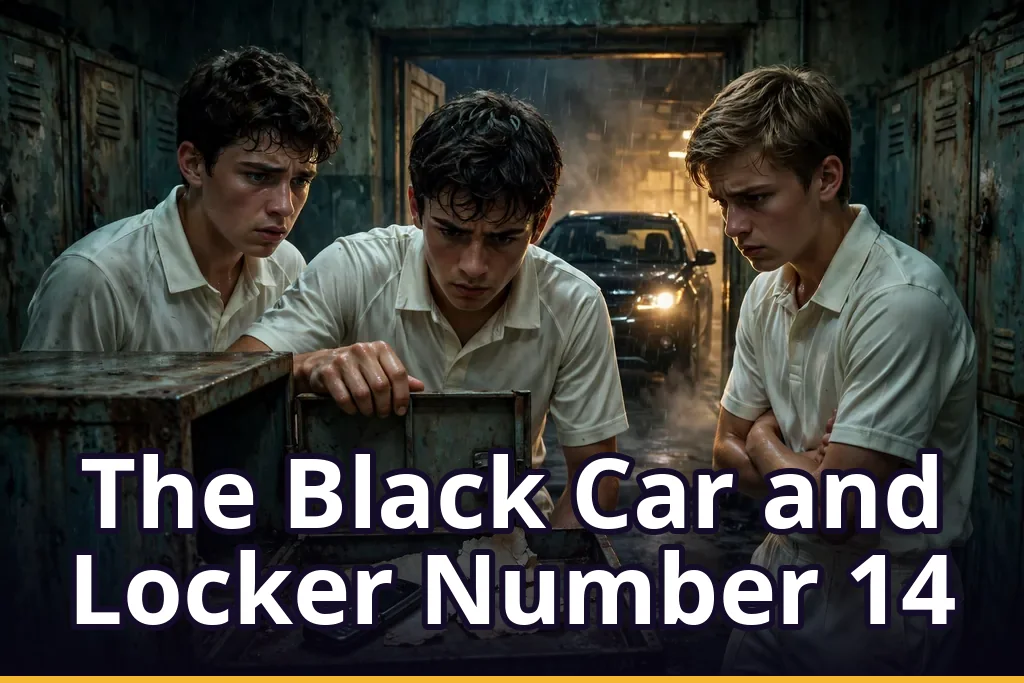
The black car stayed at the gate. Its engine was running, but nobody got out.
The five friends stood in the middle of the ground, holding the old photograph — young Rana Iqbal on one side, young Mamu Sikandar on the other, a gold watch on his wrist.
"Why has this car stopped here?" Guddu whispered. "Is it watching us, or... are we watching it?"
"Both," Salman said through his teeth, and took a step forward.
"Salman!" Coach Rana caught his arm. "Stop. Anger should have come to me today — twenty-eight years ago. But I lost to silence, not to anger. Don't you make that mistake today."
The car's window slid down slowly. In the driver's seat sat a man — white shalwar, a neat clean face, and on his lips the same faint smile that Mamu Sikandar wore in the photograph.
"Rana sahib," he said gently, "Mamu sahib sends his salaam. He says — old photographs look best in dust. Dig them out, and only dust will rise. And dust... gets into children's eyes too."
"Is that a threat?" Waleed asked.
"It is advice, Captain sahib," the man said, smiling. "The final is near. The team should focus on the final, not on old stories. By the way... where is your friend Ahmed? I hear he too used to read old stories a great deal."
Rizwan's face went white.
The man rolled the window up, the car turned, and drove away trailing dust.
"He knows," Guddu said. "He knows that we know."
"And now he also knows we are not afraid," the coach said, and his voice had back the steel it had lost years ago at the railway ground. "Listen, boys. Mamu sent me this same message in 1998 — stay quiet, or else. Today his man came himself. That means we are on the right track."
---
In the afternoon there was a practice match at the nets — against a street team from the neighbourhood. The coach had said it plainly: preparation for the final will not stop, whatever happens.
"Without Ahmed our bowling is half a team," Salman said, rubbing the ball against the tape. "But even half a team will give its full heart."
The match began. Waleed hit two fours in the opening, then was bowled by a slower one. Guddu kept everyone laughing from behind the stumps and kept them steady too — one batsman stumped, another run out on his shout. Salman bowled a yorker with his very first ball — the bat missed it, dot. The second ball came out a full toss, one run. The third was a slower one — the batsman played too early, a single.
But in the last over it happened again — Rizwan dropped an easy catch, and the street team won the match by two runs.
"We lost," Rizwan said, head bowed.
"No," Waleed put a hand on his shoulder. "We played without Ahmed, and we fought till the last ball. That is not losing — that is preparation."
And then, packing up the kit bags, Waleed stopped.
Inside his own kit bag, under his bat, lay a small slip of paper. White paper, Ahmed's handwriting.
"Railway station. Locker number 14. The key... you know where it is."
"When did this get here?" Guddu cried. "It wasn't there this morning! I opened your bag this morning — there were only bats and gloves in it!"
"That means someone reached our bags," Salman said. "The black-car man? Or... Ahmed himself?"
"'The key — you know where it is,'" Waleed read the slip again. "Ahmed's key... in the pocket of his old kit bag there was always a small key. And that bag was found at the ground — in its pocket?"
The coach nodded. "Ahmed's old bag is still in my room. Come on."
In the room, in the bag's inner pocket, there really was a small key — and beside it another slip, with only one word written on it: "Hurry."
---
That evening the railway station was crowded. Locker number 14 stood in a corner, rusted but solid. Waleed's hands shook as he turned the key.
The locker opened.
Inside were two things.
One — Ahmed's mobile phone, switched off, battery dead.
The other — a bus ticket, toward the old city, torn halfway.
"The phone is dead," Guddu said. "And the ticket... the old city? Why would Ahmed go to the old city?"
"Because nobody knows him there," Rizwan said softly. "The best place to hide is where nobody comes looking for you."
Waleed turned the ticket over. On the back, in Ahmed's handwriting, was one more line:
"The answer is in the phone. But before you hear the answer... remember why I didn't tell you."
"Why didn't he tell us?" Salman asked.
No answer came. Because at that very moment Guddu looked out of the window.
Across the station road, headlights on, stood a black car.
It was watching them.