Episode 6
Coach Rana's Old Secret
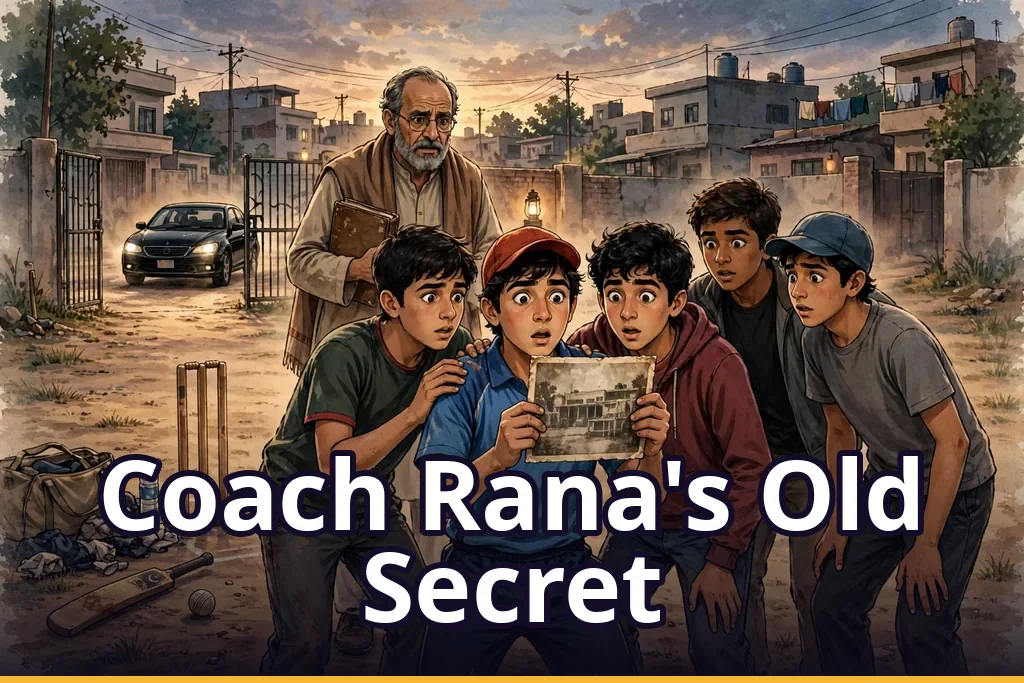
Rizwan woke before the Fajr azaan.
He hadn't slept at all. He had sat by the window all night, watching the lane. And now, in the thin early light, he saw it — the door of the house across the street opening.
Master Sadiq was coming home.
His hands were empty. The envelope was gone.
Rizwan's breath caught. The envelope — the one with the loan papers — was no longer in his hands. Which meant he had given it away. To whom? To Mamu Sikandar? And what had he taken in return? A promise? More time? Or... some other bargain?
Master Sadiq looked up at the window. His eyes were red, as if he had cried all night or not slept at all. For one moment, father and neighbour's son looked at each other — no, Master Sadiq looked at the boy who knew Ahmed's secret and had kept it.
He said only this, softly, as if speaking to the air:
"Some decisions a father has to make alone, son."
And the door closed.
Rizwan stood pressed to the window. A voice screamed inside him: if only I had told sooner. If only Ahmed hadn't made me swear. If only...
But matches aren't won with if-onlys. And neither are friends brought back.
---
At the nets that morning, Coach Rana Iqbal blew his whistle, but today his voice lacked its usual snap. He stood there holding that same old scorebook again.
"Drill today," he said. "Last-over drill. The other side needs twelve runs, six balls left. Salman, the ball is yours. Everyone else — no slack in the field. If Ahmed were here... "
He stopped. The whole ground went quiet.
"If Ahmed were here," Waleed said softly, "he'd say the last over isn't won by the captain — it's won by the team."
The coach nodded. "Then show me."
Salman rubbed the ball on the edge of the tape. First ball — an attempted yorker, but it came out a full toss, and the batsman took two runs. Second ball — on a length, dot. Third — the slower one, the batsman through the shot too early, one run.
Nine needed off three balls.
"Breathe!" Guddu chirped from behind the stumps. "The anger stays in the bowler, not in the ball! That's Ahmed's saying, not mine!"
Salman took a deep breath. Fourth ball — dead straight, the bat missed it, dot. Fifth — dot again. Last ball — the batsman swung hard, the ball rose into the air toward cover... Rizwan sprinted, dived, and the ball landed in his fist!
"Out!" Guddu screamed. "Match tied! And a tie means — we didn't lose!"
Everyone laughed, but the laughter faded fast. Because the coach was still staring at the scorebook, with that same faraway look Rizwan had noticed yesterday.
This time Waleed found the courage. He stepped forward.
"Coach," he said, "this scorebook... what's in it? Since yesterday you've been holding it like there's something alive inside."
The coach said nothing at first. Then he pressed the scorebook to his chest, like someone hiding an old wound.
"Sit," he said. "All of you, sit. Today I owe you a story — the one I've never told anyone."
The five of them sat on the grass.
"Nineteen ninety-eight," the coach said, and his voice changed — as if it had travelled twenty-eight years back. "I was a little older than you are now. I played club cricket. We reached the city final — at the railway ground."
Rizwan's ears pricked up. The railway ground. The same name that was on yesterday's slip.
"The night before the final," the coach went on, "a man came to me. White shalwar, gold watch, a faint smile. He said — just drop two catches. Two catches, and you'll have more money in your pocket than you've ever seen."
"And you...?" Salman's voice shook.
"I didn't refuse," the coach said, and the five of them held their breath. "I went to play the match. But when the moment came, when the catch came toward my hands, I caught it. I caught it, threw the ball to the ground, and walked off the field. In the middle of the match. In front of everyone."
Silence.
"We lost that final," the coach said. "And the next day everyone said — Rana ran away. Rana betrayed his team. Nobody asked why I ran. And I... I never told anyone either. I stayed silent. I have been silent for twenty-eight years."
"But Coach," Waleed said, "you did the right thing!"
"I did the right thing, but I did it alone," the coach's eyes glistened. "And doing the right thing alone is its own kind of defeat, son. I never named that man to anyone. I was afraid. And that man... he is still playing the same game today."
Guddu asked quietly: "Coach... who was that man?"
The coach didn't answer. Instead he opened the scorebook and turned to a page. It was the scorecard of the 1998 final. One name had a line drawn through it — Rana Iqbal. A crossed-out name.
And in the margin, in a young boy's handwriting, a sentence was written:
"Railway ground. The same place. The same game, again."
The five of them looked at each other. It was Ahmed's handwriting.
"Three nights ago," the coach said, "Ahmed came to my house. He asked me — Coach, if a player refuses a fixed final and runs away, is he a coward or a brave man? I told him this story. And he asked for this scorebook. He said — Coach, my answer is in here."
The coach placed the scorebook in Waleed's hands.
"Now it's yours," he said. "And from today, I will not be silent. Whatever it takes, I stand with you. Ahmed made the mistake of doing right alone — don't you repeat it."
Waleed opened the scorebook. Pages turned — old matches, old names, old wins and losses. And tucked into a pocket inside the last page lay an old photograph.
Two young men stood in the photograph. One was a young Rana Iqbal — in a club shirt, smiling. And the other...
The other was a young man in a white shalwar, a gold watch on his wrist, that same faint smile on his lips.
Mamu Sikandar. Twenty-eight years ago.
Waleed's hands began to shake.
"So Mamu..." Guddu's voice faded, "Mamu was there even then."
And at that very moment, a black car pulled up at the ground's gate.