Episode 4
The Shuttered Shop
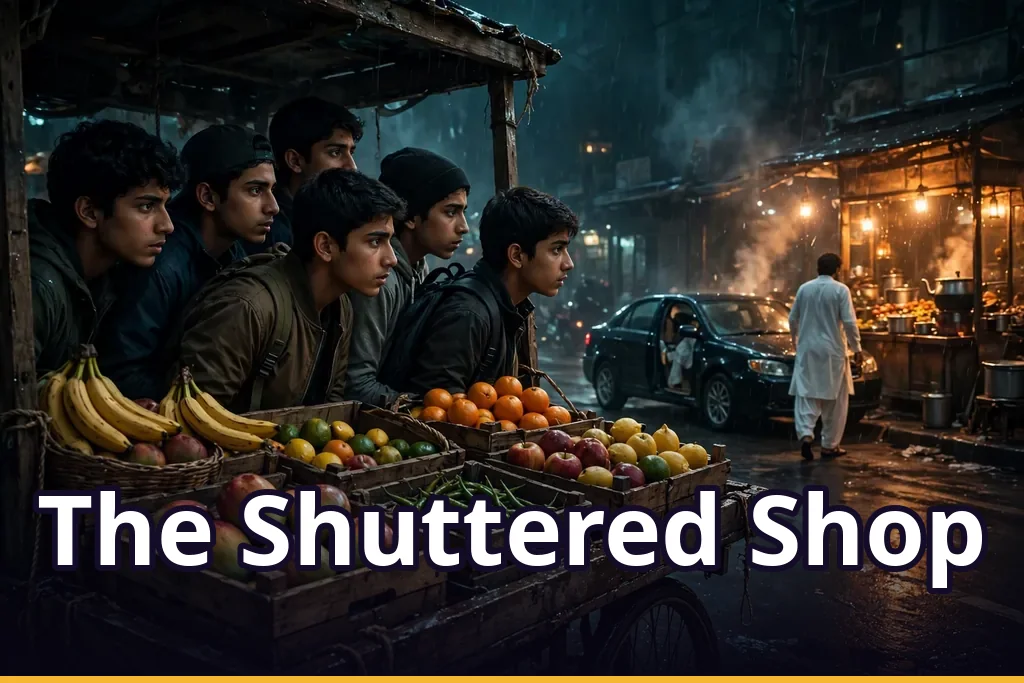
Rizwan was waiting for Waleed at the mosque door as the fajr azaan faded. His eyes were swollen, but the fear of the last three days was gone from them — replaced by a strange resolve, like someone who had made up his mind overnight.
"Let's go," he said. "I promised. I'll tell you everything. But first… first let's go to the place where it all began."
Half an hour later the five friends stood at the bend of the lane where the signboard of "Sadiq Tailors" still hung — dust-covered, cracked at one corner. Six months of rust coated the shutter, and through the glass door they could see the sewing machines that would never run again.
Rizwan touched the shutter. Then his shoulders began to shake.
"This shop is right across from my house," his voice broke. "I saw everything with my own eyes. Master Chacha took a loan to buy these machines. The old ones were breaking down one by one, work was stopping. Someone said — take it from Mamu Sikandar, he helps everyone."
"Mamu Sikandar?" Waleed asked.
"Yes. At first he acted so sweet. Three lakh rupees. He said, return it whenever you like. But then interest… interest on interest. In six months the loan had doubled. The shop shut down. Master Chacha sits at home now, and Ahmed…" Rizwan wiped his tears. "Ahmed told me all of this. He made me swear I wouldn't tell anyone. He said — it's a question of Abba's honour."
Salman clenched his fists. "So that man in the white shalwar…"
"It was Mamu Sikandar himself," Rizwan nodded. "He came to our house. I hid behind the door and listened. He told Ahmed — in the final, just bowl a few loose balls on purpose, and your father's whole loan is forgiven. Ahmed refused. Mamu laughed and said — think it over. Then that envelope… it had some cash in it, and a paper with the loan amount written on it."
Silence fell. Only a distant rickshaw rattled somewhere.
"And the night Ahmed vanished," Rizwan's voice dropped to a whisper, "I heard him arguing with his father. Master Chacha was crying. He kept saying — son, just agree, or these people will destroy us. And Ahmed shouted — I will not become a cheat! Then he walked out of the house. He never came back."
Waleed put a hand on Rizwan's shoulder. "You swore an oath, Rizwan. You're not the guilty one here."
"But I… I left him alone…"
"We won't leave him alone now," Waleed said.
---
That same morning Coach Rana Iqbal had the nets up at the ground. Less than twenty-four hours remained to the final.
"Death overs today," the coach blew his whistle. "Salman, you'll bowl. And this time, leave your temper at home."
Salman took the ball, ran in, and the first ball — right on yorker length. The second — a slower one, the batsman completely deceived. Third, fourth, fifth — all on the line.
From behind the stumps Guddu started chirping — for the first time in three days: "Oho! Salman has turned into a gentleman today! Looks like someone taped up his temper last night!"
Everyone laughed — the first real laugh in three days.
"Shut up," Salman said, grinning, but his balls were still landing on the line. "Ahmed taught me — the anger should be in the bowler, not in the ball."
Waleed tried Ahmed's yorker too. The first attempt turned into another full toss.
"Give it up, man," Guddu said. "You're an opener. You make the runs in the final; yorkers are our department."
Coach Rana came over. He put a hand on Waleed's shoulder. "Ahmed or no Ahmed, tomorrow the ball still has to be bowled. And remember — the biggest win in cricket is not always on the field. Sometimes it's off it."
Waleed looked at the coach. There was something old in his eyes — a secret he wasn't telling yet.
---
By afternoon there was the old gleam in Guddu's eyes — the one that only appears when his "gossip network" delivers.
"Found it!" he announced. "My uncle's rickshaw-driver friend has dropped that white-shalwar man twice — at 'Sikandar Tea House' near the bus stand. And listen — in the back room there's a big TV, matches play, and people write slips."
"Slips?" Salman asked.
"The kind of slips bookies write," Guddu said quietly. "It's Mamu Sikandar's den."
"Then we go there," Waleed decided. "But carefully. No fighting. We only watch."
"Promise from my side," Salman said — and everyone noticed that this time his fists hadn't clenched.
That evening the five were in the lane across from the bus stand. Sikandar Tea House was an old tea-stall — people sipping tea on the benches outside, an old match blaring from the TV inside. The back room's door was half open, and from it came the murmur of slips and cash.
The five crouched behind the fruit cart across the road, watching.
"Look," Guddu whispered.
A black car pulled up — tinted windows, number plate smeared with mud. A man stepped out — white shalwar-kameez, a gold watch on his wrist, that same faint smile on his lips. Everyone sitting in the tea-stall stood up.
"That's him," Guddu's voice trembled. "Mamu Sikandar. The same one… the same one from the railway ground."
Five hearts pounded. Waleed said softly, "Let's go back. That's enough for today —"
At that very moment a heavy hand landed on Waleed's shoulder.
"Oi, boys!" a rough voice said. "What's this spying behind the cart?"