Episode 3
The Midnight Meeting
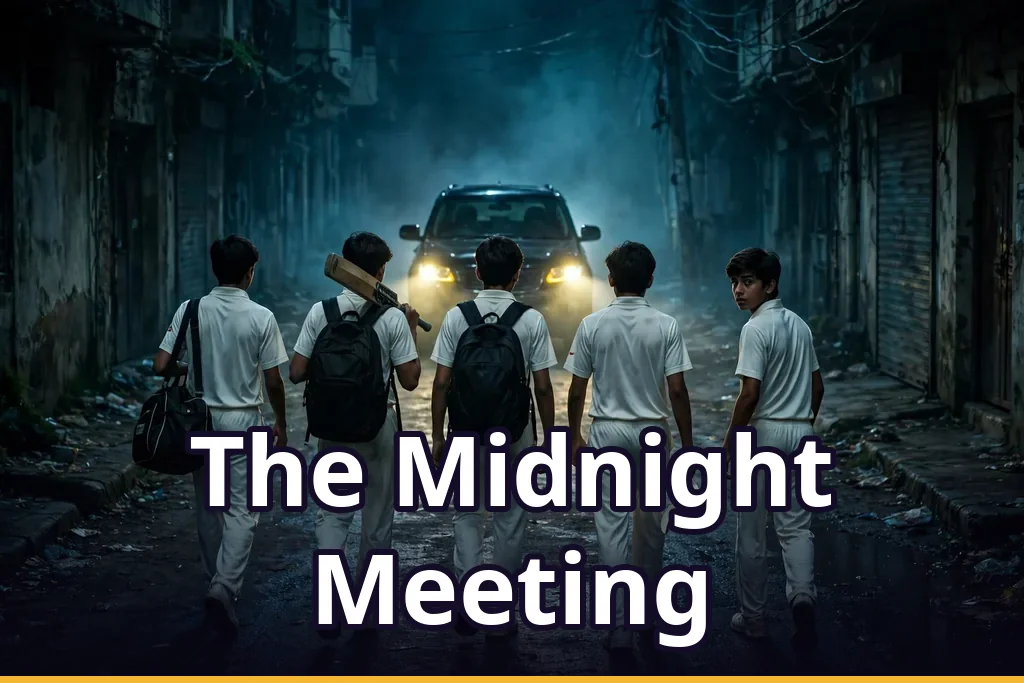
Less than thirty hours to the final, and the five friends gathered at the empty ground at dawn — the same ground where Ahmed's kit bag had been found two days ago.
Rizwan's eyes were red. He hadn't slept all night.
"Waleed bhai…" he said quietly, "what I have to tell you… not today. Give me one more night. Tomorrow morning, after fajr, I'll tell you everything. I promise."
Salman opened his mouth to argue, but Waleed raised a hand. "Fine," he said. "One night. But Rizwan — no excuses tomorrow morning."
Rizwan nodded, and a relief washed over his face like a mountain lifting off his shoulders.
Coach Rana Iqbal arrived and blew his whistle. "Death-overs practice today. Without Ahmed. Whoever bowls the last over in practice bowls it in the final."
Practice was another disaster. Salman bowled two wides in a row in anger. Guddu had stopped chirping from behind the stumps — his silence was becoming the team's new normal.
"Give it here, I'll bowl," Waleed picked up the ball. He tried Ahmed's yorker — the ball smacked the batsman's knee. His second attempt was a full toss that sailed over the boundary.
"Stop, man," Guddu said, "you're an opener, not a magician."
Nobody laughed.
That evening, after practice, the five sat on the pavilion steps when Waleed said what was on everyone's mind:
"Remember? Ahmed's last net session?"
---
Two days earlier. Soft evening light on the ground. Ahmed was bowling in the nets — Salman on strike.
The first three balls were the worst of Ahmed's life. A wide, a full toss, and one that landed two feet outside the pitch.
"Oi!" Salman yelled. "Are you asleep?"
Ahmed didn't answer. His eyes kept darting to his pocket, where his phone was. Then it buzzed — twice. Ahmed glanced at the screen, and his face hardened, as if someone had slammed a door shut inside him.
"It's Ammi calling," he said — but the voice didn't carry the truth Ahmed's voice always carried. "I have to go. An hour early."
"But the nets —" Waleed began.
Ahmed picked up his bag. Then he stopped. He picked up a ball, walked back two paces, ran in, and let it go.
The ball floated through the air and landed on a perfect yorker length — Salman's bat stayed in the air, and middle stump lay flat on the ground.
Silence.
"If that lands in the final, Star Academy are finished!" Waleed said happily.
Ahmed smiled — but the smile never reached his eyes.
"In the final…" he said softly, "we'll see."
And he walked away. It was his last net session.
---
"He made that face when he saw the phone," Guddu said, "like someone had threatened him."
"Or like someone was calling him," Rizwan said quietly. Then he fell silent — as if he realised he'd said too much.
"So what about the number?" Salman asked.
For the first time in two days, the old gleam returned to Guddu's eyes. "My gossip network never fails. That number belongs to the old railway colony exchange. Numbers like that only go to railway staff quarters. And the railway ground's old pavilion — the chowkidar is on duty there at night."
"So tonight we go to the railway ground," Waleed decided.
---
At eleven that night, the five stood outside the railway ground's old pavilion. A yellow bulb flickered above the wooden structure, and a radio murmured from inside.
The chowkidar, Abdul Rehman — near seventy, white beard, a stick in his hand — flared up at the sight of them. "What are you doing here at this hour? Get lost!"
"Chacha, we're cricket boys," Guddu said in his sweetest voice. "We brought tea for you in a flask. With ginger."
Abdul Rehman looked at the flask, then at Guddu. "With ginger?"
Ten minutes later he was sitting on the pavilion bench with the five, sipping tea. Waleed took out the taped ball and showed him the number.
The old man's face changed. "This number… where did you get it?"
"Our friend Ahmed left it," Waleed said honestly. "He's been missing for two days. Chacha, three nights ago, at midnight, he came here — did you see him?"
Abdul Rehman set down his cup. He was quiet for a long time. Then he spoke:
"He came. Carrying a kit bag. It was midnight. I thought he was a thief and raised my stick — then I saw he was just a boy, a cricket boy. He sat in the pavilion, like he was waiting for someone."
The five asked together: "Then?"
"Then a car came. Tinted windows. A man stepped out — white shalwar-kameez, expensive perfume. He sat with the boy. He did most of the talking. Twice he called the boy 'beta' — but that 'beta' didn't have the love a father's 'beta' has."
Rizwan's voice trembled: "Then what happened?"
"The man gave the boy a small envelope. The boy opened it, looked inside — and his face went white. Then… then I heard that boy speak loudly for the first and last time. He was arguing. Angry. I had never seen such a decent boy so angry."
"And the man?"
"He laughed. Softly. Then he got up, sat in the car, and left. The boy sat alone here for an hour — on this very bench where you're sitting. Then he stood up, picked up his bag, and walked into the dark."
Silence fell over the pavilion. Only the bulb's hum could be heard.
"Chacha," Waleed said slowly, "did that man leave anything behind?"
Abdul Rehman got up, went inside, and returned with a crumpled paper napkin. On it, two words were written in a hurried hand — in Urdu:
"Soch lo." Think it over.
"Found it next morning while sweeping," the old man said. "I kept it. An old man feels… some papers should be kept."
Waleed slipped the napkin into his pocket. His hands were shaking.
---
It was past midnight on the way home. The lane was deserted. The five walked in silence — each picturing the same image: Ahmed, alone, in the midnight pavilion, an envelope in his hand.
Then they saw the headlights.
A car slowed at the bend of the lane — and began crawling behind them. Tinted windows. Number plate smeared with mud.
"Don't run," Waleed said through his teeth. "Walk normal. Don't show them we're scared."
The five kept walking. Hearts hammered against ribs. One lane — the car alongside. At the next bend it stopped, then turned and vanished into the dark.
At that moment Rizwan's phone buzzed.
A photo had come from an unknown number — the five of them, standing outside the pavilion, taken minutes ago. Underneath it:
"Go home. Focus on the game."
The five stood frozen.
At his doorstep, Rizwan grabbed Waleed's hand. There were tears in his eyes, but for the first time there was steel in his voice:
"Tomorrow morning. After fajr. I'll tell you everything. I promise."
Waleed walked home. One thought echoed in his mind: now they're watching us — which means we're on the right track.
And somewhere in this same city, Ahmed was alone — with the envelope that had turned his face white.