Episode 10
The Truth Comes Last
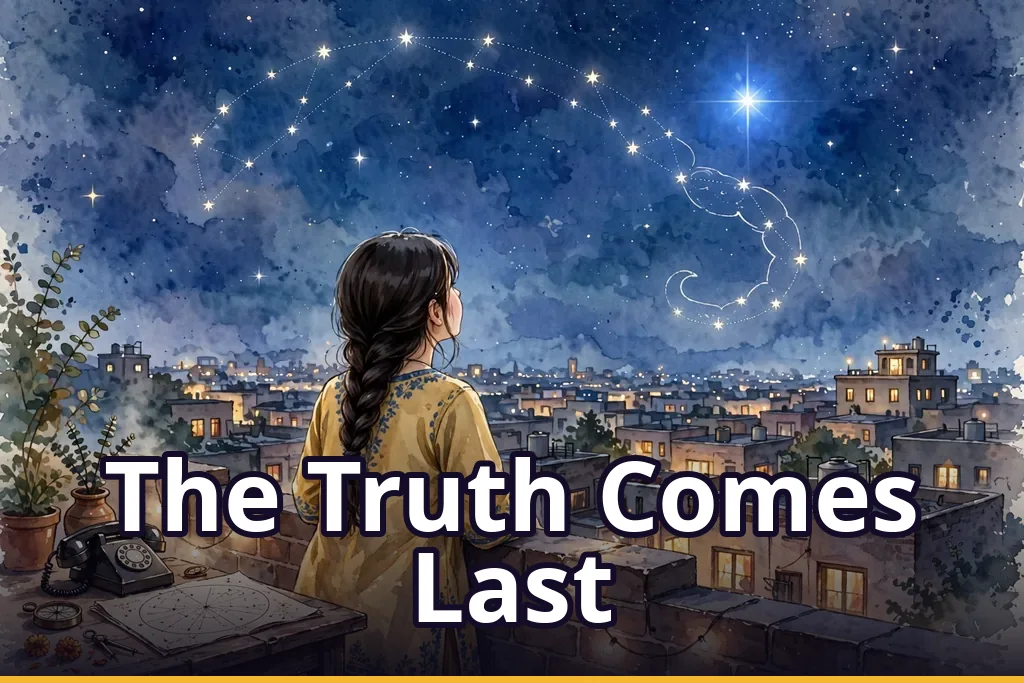
The line was dead before she finished saying his name.
Zara stood in the hallway with the receiver pressed to her ear, listening to the silence where her brother's voice had been a second ago. "Bhai?" she said again. "Bhai, can you hear me?" Nothing. Only the flat, empty hum of a line that had given up.
Ammi was on the stairs behind her, one hand on the railing. "What happened?"
"The line cut," Zara said. She put the receiver back gently, the way you put down something that might still be alive. "He'll call back."
She said it like a fact, because she needed it to be one. He had torn up the ticket. A boy who tears up his ticket does not disappear. A boy who tears up his ticket calls back.
She did not go back to the roof. She sat on the bottom step of the stairs, where the phone could see her and she could see the phone, and she waited. Ammi sat down beside her without a word and put a hand on her knee, the way mothers do when they do not know what is wrong but know exactly where to sit.
The house was quiet. Abu was still at the kitchen table with the bookshop's accounts. Somewhere upstairs, the star chart lay open on her desk, Leo circled in pencil, and through the window Scorpius was climbing over the rooftops, its tail curled like a question mark.
Ten minutes passed. Then ten more. Zara counted the tiles on the hallway floor twice, and was starting the third count, when the phone rang.
She had the receiver in her hand before the second ring.
"Zara?" His voice — tired, far away, and this time, staying. "I'm calling from the booth. The coins ran out. I put in one more."
"Don't stop talking," she said. "Please. Just this once, don't stop."
And he didn't.
It came out the way water comes out when a dam breaks — not in order, not neatly, but all of it, at last. The midterm in mathematics, the one he had failed by eleven marks. The nights at Seth Nadeem's print shop, the ink under his nails, the machines that never stopped. The preparation classes he could not attend because the evenings belonged to the presses. Professor Saleem's office, and the warning, and the word "hearing" said in a voice that made it sound like a door closing. The scholarship — the only reason he could stay in Karachi at all — hanging on that hearing. The telephone booth, and Ammi's hello, and the coins that came back because he could not find the words. The ticket. The Friday-night bus. The plan to come home and say the university had sent him away, so that no one would ever know he had given up first.
"I'm sorry," he said at the end, and his voice was smaller than she had ever heard it. "I'm sorry I made you carry it. You were supposed to be the little sister. You were supposed to be the one I protected."
Zara looked at Ammi sitting beside her, at the hand on her knee, and she thought of Abu at the kitchen table adding the same column twice, and she understood something she had been circling for weeks without naming.
"Bhai," she said. "Ammi already knows about the bookshop."
Silence on the line. Then: "What?"
"She knows the shop has had bad months. She told me herself, weeks ago. And Abu — Abu sits at the kitchen table every night with the accounts, adding the same column twice, smiling that quick smile so nobody worries. You think you're the only one hiding a worry to protect us. You're not. This whole house is full of people carrying things alone and calling it love."
She heard him breathe — a long, shaky breath, like a boy coming up from underwater.
"So stop," she said. "Stop carrying it alone. That's what the star is for. Every Friday, same time, same sky — that was never about the star, Bhai. It was about not being alone while you look."
"The hearing," he said quietly, "is next Friday."
Zara's hand tightened on the receiver.
"Next Friday," he said. "The same night as the star watch. The same hour. Professor Saleem will be there. I have one week, Zara. One week to learn the mathematics I missed, to sit in the preparation classes, to walk in there and prove I am worth keeping. And while it happens — while they decide — you'll be on the roof, watching a star."
"Then we'll all be watching," she said. "And you'll be looking at the same sky."
Ammi squeezed her knee. "Sab theek hai?" she whispered.
"Ab theek ho raha hai," Zara whispered back. Getting better now.
After the call ended — properly this time, with a goodbye and a promise, not a dead line — she climbed back to the roof. The night was cold and clear. Scorpius stood over the rooftops, its tail curled, its sting at the very end, exactly where the chart said it would be. She opened her notebook and wrote, in her neatest handwriting: hearing — next Friday, same hour as the star watch. Then she circled the tenth constellation in pencil. Scorpius. The scorpion.
She read the note aloud, to the scorpion and to the star and to the brother who was, somewhere in Karachi, looking at the same sky: "The scorpion's sting is in its tail — the truth comes last."
The truth had come last. All of it, in one call.
And next Friday, at the same hour as the star watch, her brother would stand in a room in Karachi and find out whether the truth was enough.