Episode 9
The Tribute Gate
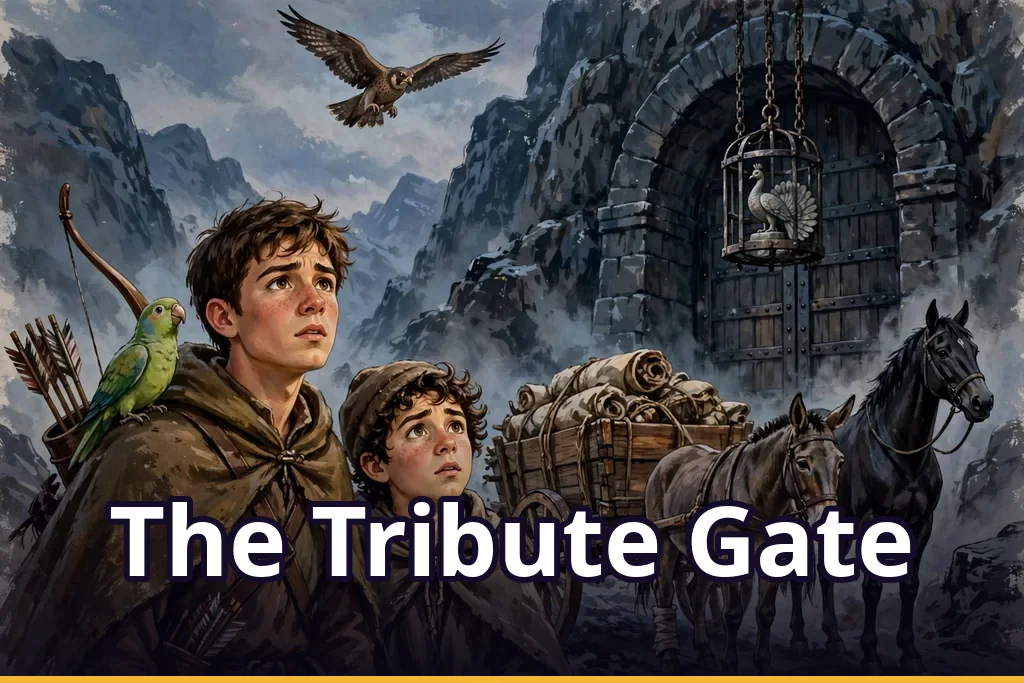
Mehran stood at the edge of the forest, and his heart pulled in two directions at once. One road led to Koh-e-Siyah, where the fifth piece lay locked inside Qahhar Shah's tribute vault. The other road led back to Zarnabad, where his mother and his little sister stood alone before a spy. He pressed his hand to his chest. Inside the pouch, four golden pieces lay warm and heavy, like four small hearts beating.
“I cannot walk both ways,” he said quietly.
“Then walk the way your father lies,” said Sahil, his voice shaking, though he stood firm beside Mehran. “Ammi and Noor are not alone. The whole city stands with them. And there is Shahin.”
Shahin circled above them, restless and sharp. Mehran picked up a golden feather the peacock had dropped on the moss. He held it out gently and said, “Fly home, friend. Drop this feather at Noor's feet. She will understand. Circle the kitchen three times, so Ammi knows we are alive and moving forward.”
Shahin took the feather in his beak, gave one keen cry, and flew towards Zarnabad across the morning sky. Mehran watched until he became a small dark point. His throat tightened. “Ammi,” he said in his heart, “keep your kitchen open. I will come back.”
Sabz bobbed on his shoulder and repeated, in Zaar's cold voice, “How many bowls of stew… how many bowls of stew…” Then, quickly, in his own hurried voice, he repeated Zainab Bibi's words, “Generosity is the greatest sword… generosity is the greatest sword…” as if he were comforting himself.
“Come,” said Mehran. “Koh-e-Siyah is waiting.”
The road changed quickly. The trees thinned, the grass ended, and the ground turned to black stone. The wind was cold and sharp, and at every turn the mountain grew larger, like a black wall standing in the sky. Toofan tossed his head and walked slowly, as if he too knew this place and feared it.
By midday they reached the tribute road. It was cut deep by the wheels of carts and wagons. Every wagon was loaded with grain, cloth, and copper pots, and beside every wagon walked a weary man with his head bowed. At the side of the road stood a thick wooden gate, and Qahhar's soldiers stood beside it. They stopped every wagon and counted, “One sack short… two sacks short… Qahhar Shah wants it all.”
Sahil whispered, “Mehran, there is no way through here. They look at every face.”
“Then we will not show our faces,” said Mehran. “We will show our hands helping.”
At that very moment there was a noise on the road. An old wagon's wheel sank into the mud, and its mule stumbled and nearly fell. On the wagon sat an old man with a white beard and a torn cloak, and beside him a small girl shivering with cold. A soldier raised his whip. “Move! Qahhar Shah does not wait!”
Mehran did not think. He stepped forward, slid his bow from his shoulder, and knelt beside the mule. “Brother, do not strike him. The mule is tired, not sick. The wheel is stuck, not the animal.”
The soldier glared at him. “Who are you?”
“A traveller,” said Mehran, “whose hands are not empty.” He untied his rope, looped it around the wheel, and handed Toofan's reins to Sahil. “Toofan, gently… pull.” Toofan strained, Sahil pushed, the old man lifted the wheel, and the wagon rolled free of the mud.
The soldier lowered his whip and walked on, grumbling. He did not care who had freed the wagon, only that it was moving again.
The old man's eyes filled with tears. “Son, my name is Kaka Rahim. This is my granddaughter, Amina. We have travelled three days. The tribute must reach Qahhar Shah, or our village will go hungry.” He looked at the girl, who was watching Mehran with wide eyes. “She has eaten nothing since morning.”
Mehran had only two flatbreads left, the ones Sahil had saved that morning. Sahil looked at Mehran, then at the girl, and sighed. “Give them,” he said. “We… we will find something later.”
Mehran gave the bread to Amina. She ate one piece at once, then broke the second in half and gave it to her grandfather. “Dada, you eat too.” Kaka Rahim took the bread, and his beard grew wet with tears. “May God keep you safe, son. On this road, no one gives anything to anyone. Everyone is afraid.”
Sabz at once copied the soldier's voice, “Tribute! Tribute!” and then made the sound of a mule, which made Amina laugh. Her laughter was like a small light on that black road.
Kaka Rahim sat beside his wagon and said quietly, “Son, you look like a good man. So listen to one thing. Qahhar's vault lies inside the mountain, but its door opens only when the evening bell tolls, when the tribute is counted. The carriers go in and come out empty-handed. The keeper of the vault writes every piece of gold in a book. And…” His voice grew even quieter. “Yesterday a crow sat on my wagon. It spoke like a man. It said the wazeer knows that the boy with four pieces is coming.”
Mehran's heart beat hard, but he kept his face calm. “Then we must hurry.”
“And one more thing,” said Kaka Rahim. “Behind the vault there is a small servants' passage, where the kitchen goods go in. No soldier stands there, because Qahhar is certain no servant would steal his treasure.” He looked into Mehran's eyes. “You do not look like a servant, son. But sometimes the door opens where no one is looking.”
At that same hour, far away in Zarnabad, Shahin reached the kitchen.
Noor was sharing out bread when she heard his cry circling overhead — once, twice, three times. She ran into the courtyard, and Shahin dropped the golden feather at her feet. Noor picked it up, pressed it to her chest, and closed her eyes. “He is alive, Ammi! He is moving forward!”
Zainab Bibi looked at the feather and smiled, though her eyes were wet. “Then tonight the kitchen will stay open all night. No one will sleep hungry, and no spy will sit alone.”
That evening Noor saw a small black mark on the doorpost — like the print of a crow's foot. Someone had quietly marked the door, so the spy could find it again at night. Noor washed the mark away with water, hung a lantern on the post, and sat down beside the door. “No secret will pass through here tonight,” she told Shahin, who sat on the roof. “And tell Mehran — home is safe.”
In the valley of Koh-e-Siyah, evening came. Kaka Rahim gave Mehran and Sahil two old cloaks, like the ones the tribute carriers wore, and said, “Keep your heads bowed. Say nothing. When the bell tolls, walk behind the wagon.” Sabz hid inside Sahil's turban and whispered, “Say nothing… say nothing…” which made Sahil almost laugh, and he quickly covered his mouth with his hand.
The bell tolled — a deep, heavy sound that echoed in the mountain's chest. The great gate opened. The wagons began to roll inside. Mehran and Sahil walked behind the wagon, heads bowed, hearts beating hard. Inside, it was dark, and the air smelled of gold and smoke.
And then Mehran saw it.
Above the door of the tribute vault, in a cage of iron, sat the Stone Peacock. His tail was folded, his eyes half open, and his gold had grown dim. He was not singing. He was silent, as if someone had closed a hand over the music.
Mehran's steps stopped. Sahil caught his arm. “Keep walking,” he whispered. “Not yet.”
The peacock opened one eye. He looked at Mehran. For a single moment, the old light flickered in that eye — the light of the forest, the light of the song. Then the eye closed again.
And behind them the bell tolled a second time, and the great gate shut with a sound like a stone door closing on a tomb. Mehran understood: they were inside Koh-e-Siyah now, and there was no road back — except through the door of the vault.