Episode 8
The Dawn Test
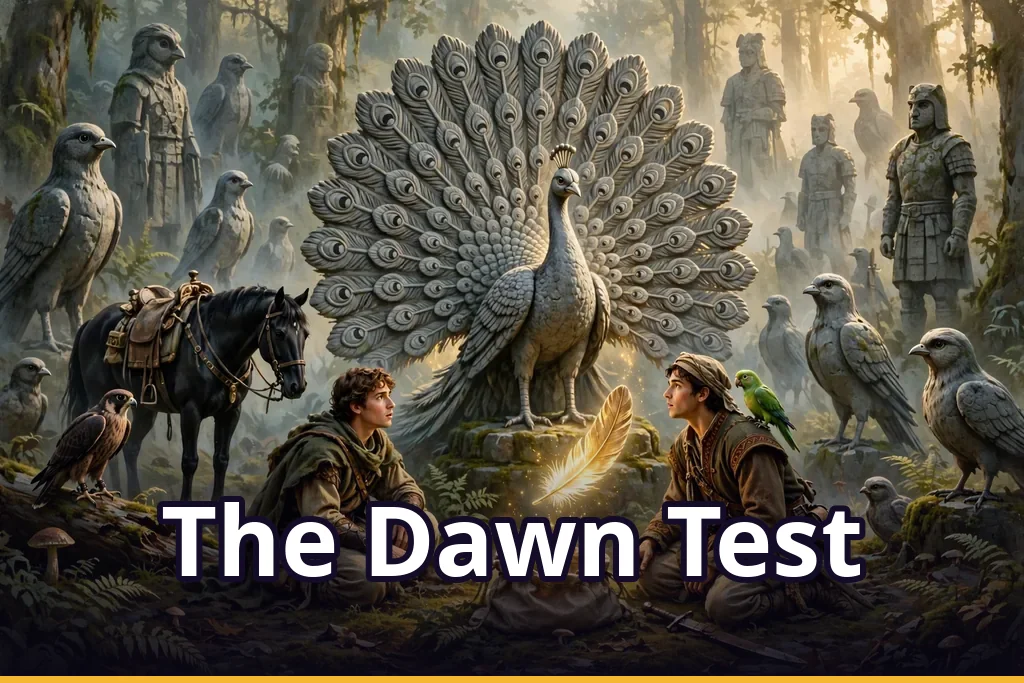
Sahil did not scream. That frightened Mehran more than any scream could have. His best friend stood frozen at the forest's edge, his face white in the moonlight, while a grey stone hand closed tighter around his ankle.
"Mehran," Sahil whispered. "It is holding me."
Mehran's hand flew to his father's sword. Then he stopped. The peacock had warned them: the soldiers were not monsters. They were men Qahhar Shah had turned to stone long ago — men who had once walked home to their families. His father had never raised a sword against a prisoner.
"Do not pull," Mehran said, kneeling slowly. "Pulling will only make it hold harder. Sahil, breathe. Talk to me. Tell me something ordinary."
"Ordinary?" Sahil's voice shook, but a shaky laugh escaped him. "My mother makes the best dal in Zarnabad, and Toofan once ate my new turban, and I am still angry about it."
"Good," Mehran said, though his heart was hammering. "Keep talking."
He looked at the soldier: half-buried, moss on his shoulders, one stone shoulder cracked like the sparrow's wing, a small round stone locket at his neck. A father, Mehran thought. Someone had loved this man once.
"Brother," Mehran said softly, in his mother's gentle voice. "We are not your enemies. We are not Qahhar's men. I am Mehran, son of Sardar Aman Khan. We only came to ask the forest for something stolen from my father."
The hand did not loosen. But the hollow eyes moved slowly towards Mehran's face.
Sabz fluttered onto his shoulder and whispered in a rough voice that was not his own: "The stone soldiers... march... the stone soldiers... march..."
"Not tonight," Mehran said firmly. "Not tonight, you will not march for him."
Slowly, he untied his water-skin. Only a few drops remained — their last water. "Mehran, that is our last water—" Sahil began.
"I know," Mehran said. He tipped the skin, and the last drops fell onto the soldier's stone hand. "For you, brother. You have slept in dry earth so long. Even stone must be thirsty."
Then he took off his own warm cloak — the one Zainab Bibi had sewn for him — and laid it over the soldier's shoulders, as his mother would cover a sleeping guest. "Sleep. Rest. No one will march tonight."
For a long moment, nothing happened. Then, with a sound like dry leaves, the stone fingers loosened one by one, and the hand opened. Sahil was free.
Sahil stumbled back, laughing and shaking. "It let go!"
The soldier did not rise. His head sank back and his eyes closed. But before they closed, Mehran was sure the open stone hand had turned its palm upwards — not a fist, but an open hand, like a man receiving a gift.
"Thank you, brother," Mehran whispered. "I will come back for all of you."
They waited through the night beside the little stone sparrow, and no hand reached for them again.
In the darkest hour, Sabz murmured, "The blind beggar... knows the ring..." Mehran asked where he had heard it. "At the dastarkhwan," Sabz muttered, in an old man's voice. "The blind beggar at the gate... he knows..."
Far away in Zarnabad, Noor was also listening.
The merchant with the crow's feather had come back, just as she had warned her mother he would. He brought no grain this time — only smooth, sweet questions about the darbar, its keys, and its storerooms.
Noor met him with a polite smile. "You must be hungry from the road," she said, and led him not to the darbar but to the free kitchen, where Zainab Bibi was serving travellers.
Before a crowd of hungry strangers, he could ask nothing in secret. Noor kept him busy — bread, stew, more bread, questions about the road — until the kitchen emptied. He left with bread and nothing else, but a crow's feather slipped from his turban to the ground.
Noor picked it up in silence and carried it to her mother. "Ammi, he is Zaar's man. He will come a third time, and next time he will not come alone."
Zainab Bibi held the feather over the lamp flame until it blackened. "Then next time we will feed the whole street, and he will find a hundred witnesses and no secrets at all. Your brother gives to strangers in a forest, Noor. We will give here."
Noor nodded, her eyes wet. "Ammi, bring him home safe." Zainab Bibi held her close. "That is what the dawn is for."
And in the forest, the dawn came. First gold at the trees' edge, then stone wings shifting as every bird turned to the light. Then the peacock came down, step by step, his tail folded tight.
"The forest has waited all night," the peacock said. "Now it will ask."
"I am ready," Mehran said.
"Give me what you love most," said the peacock. "Give it, and expect nothing in return. If your heart is greedy, the piece will burn your hand. If your heart is true, the tail will open."
Mehran's hand went to his father's sword. He laid it on the moss. "Take it. It is the dearest thing I own."
The peacock shook his great head, gently. "Not the sword. The sword is iron. Iron can be remade. The forest asks for what your heart holds tightest — what you would not give, even to save yourself."
Mehran stood frozen. He knew. Oh, he knew.
His hand moved to the small pouch against his chest — the three golden pieces he had already won. His hope. The only road back to his father.
"No," Sahil said at once. "Mehran, no. Not those."
"Without them," Mehran said quietly, "Abba is still my father. And with a greedy heart, I will never reach him at all."
Sabz repeated in Zainab Bibi's own voice: "Generosity is the greatest sword... generosity is the greatest sword..."
Mehran untied the pouch. For one moment he held it tight, thinking of the upward river, the silent city, the desert well, and the little stone sparrow. Then he opened his hand and laid it on the moss, beside the sword. He expected nothing. He asked for nothing.
"That," said the peacock, his voice trembling like a song about to break, "is giving."
And the tail opened — feather by feather. The feather-shaped piece rose, floated down, and settled upon the open pouch. Four pieces.
The peacock pushed the pouch gently back to Mehran's feet. "Take them. All four. The forest does not keep what is given freely. It returns it, and adds its own gift besides."
Mehran picked it up with both hands, shaking with joy. Four of five. Only one piece left.
But the peacock's warning was already coming true. The earth trembled. At the forest's edge, stone soldiers were rising, one after another. The soldier with the cloak rose last, and slowest.
"They are awake! Run!" Sahil cried.
But Mehran did not run. He looked at the peacock — and the peacock sang.
It was a low, sweet song, the first song of the forest, the song he had refused to sing for Qahhar Shah. As it rose, the soldiers stopped. Their arms sank back. Their eyes softened, as if remembering something they had loved long ago.
The soldier with the cloak stood longest. Then he bowed to Mehran and sank back into the earth to sleep.
The song faded. The soldiers slept again.
"Go now," said the peacock. "Go to Koh-e-Siyah. The fifth piece lies in Qahhar's tribute vault. And listen to your parrot. The blind beggar at your father's gate knows more about the ring than any king. When the ring is whole, find him."
Toofan stamped beside them as they almost reached the forest's edge, when Shahin's cry changed — sharp, urgent, a warning.
A crow landed on a bare branch above them. Its feathers were too black, its eyes too knowing. When it spoke, it spoke in Zaar's voice — smooth, sly, and cold.
"Four pieces, little Sardar," said the crow. "How clever. How generous. Qahhar Shah is counting them too. And while you gave away water in a forest, your mother's kitchen has been feeding his spy. Tell me, generous one — when his army marches on Zarnabad, how many bowls of stew will stop it?"
The crow rose into the pale sky, laughing a crow's laugh. Sabz, trembling, repeated in Zaar's own cold tone: "How many bowls of stew... how many bowls of stew..."
Mehran stood at the forest's edge with four pieces of gold against his heart, the road to Koh-e-Siyah before him, and Zarnabad far behind him. For the first time, he could not walk in both directions at once.
And from the forest behind him, faint and far away, the stone peacock sang one last note — and then stopped, mid-song, as if someone had closed a hand over the music.