Episode 7
The Forest of Stone Birds
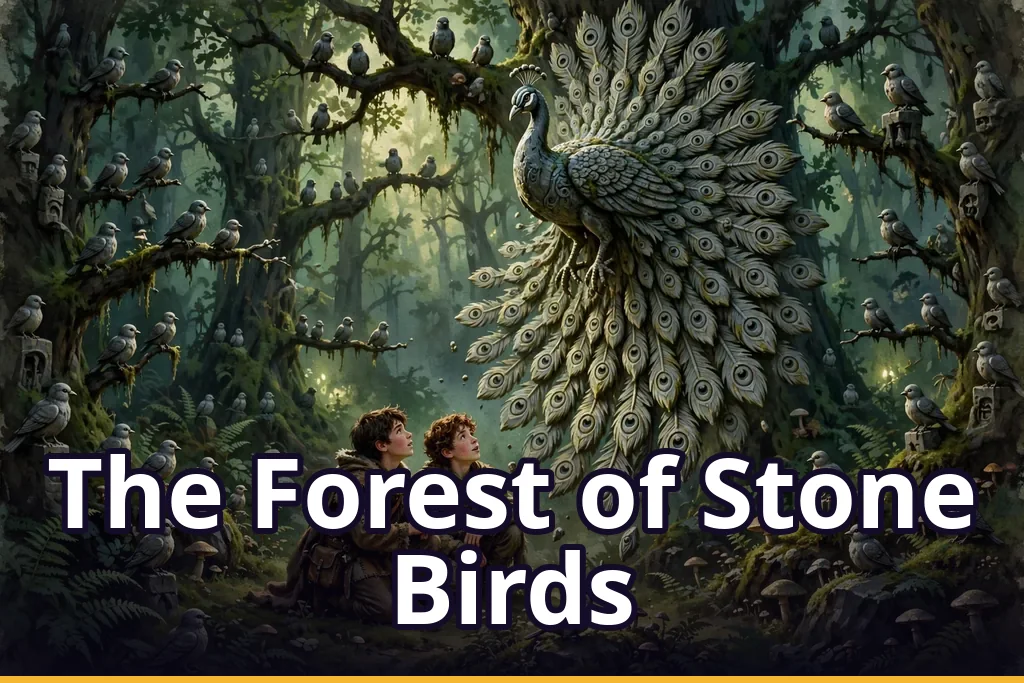
The storm had passed in the blink of an eye, but the world it left behind did not feel like the same world. Where the Desert of Sand had stretched flat and empty the evening before, a forest now stood — tall, dark trees with thick leaves, and on every branch a bird of stone.
Hundreds of them — sparrows, doves, nightingales, eagles — all grey stone, all silent, heads bowed as if listening to something far away.
Mehran stood at the forest's edge with his father's sword at his hip and the three golden pieces of the ring safe in a cloth pouch inside his shirt. Three steps closer to Abba, he thought — and yet his heart was heavy. A forest full of birds that could not sing felt like a darbar full of people who could not speak.
"Abba would have fed every one of these birds," he whispered.
From Sahil's turban, Sabz repeated softly, "Fed every one… fed every one…"
Shahin circled high above the trees and gave a sharp cry — a warning cry. He would not fly between the branches.
"Even Shahin is afraid," Sahil said, trying to laugh, though his voice shook. "And I am supposed to be the brave one? Mehran, my knees are already asking me to sit down."
"Then let them sit later," Mehran said, smiling. "Come. Slowly."
Toofan stepped into the forest first, his ears flat, his hooves quiet on the soft earth. The light under the trees was green and dim, like the light at the bottom of a well. No bird sang, and no leaf rustled. It was the quietest place Mehran had ever walked through.
Then, near the roots of a great old tree, Mehran stopped.
A small stone sparrow had fallen from its branch. It lay on its side in the moss, one stone wing cracked, one stone eye open and staring at the sky. It was the smallest bird in the whole forest, and somehow it looked the loneliest.
"Oh," Sahil breathed. "Look at it. It fell, and nobody picked it up."
Mehran knelt down. He knew the bird was stone — he could feel how cold and hard it was when he lifted it in both hands. And yet he did what his mother had taught him to do for any living thing that had fallen: he set it gently upright in the soft moss, propped its cracked wing with a folded leaf, and poured a little water from his skin over the moss around it, so that at least the ground beneath it would be cool.
"There," he said quietly. "Even if you cannot drink, you will not lie in the dust."
Then, from his own small bag of dates — the last of their food until the next village, whenever that might be — he took three dates and laid them in a row before the little sparrow.
"For you," he said. "You sang once, I am sure. This is for that song."
Sahil stared at him. "Mehran! Those were our last dates! And this bird is stone! It cannot eat!"
"I know," Mehran said. "But giving is not a bargain. Ammi says generosity is the greatest sword — and a sword is not kept in its sheath until it is useful. It is used when it is needed, even if no one sees it."
Sabz hopped down onto Mehran's shoulder and, in his most solemn voice, announced: "Dates! Dates!"
And then the forest changed.
It did not change loudly. It changed the way dawn changes the sky — slowly, and all at once. A sound rose from the tallest tree, like a great fan opening: stone sliding against stone. The stone peacock from the night before — the one that had turned its head and looked at them — spread its tail down from the highest branch and floated to the ground before them, step by step, as if it were walking down invisible stairs.
Its tail was the most beautiful thing Mehran had ever seen, even in stone: a hundred carved eyes, each one perfect, each one closed. And in the very centre of the tail, half-hidden between two feathers, something glimmered gold — shaped like a feather, thin and bright.
The fourth piece.
Mehran's breath caught. Sahil grabbed his arm.
"Do not touch it yet," the peacock said.
Its voice was deep and slow, like a song remembered from long ago. Its stone beak barely moved, but its eyes — oh, its eyes were alive. Sad, proud, and alive.
"I was the singer of this forest," the peacock said. "When Qahhar Shah came with his black mountain magic, he ordered me to sing for him, so that his soldiers would march to my music. I refused. So he turned my whole forest to stone — every singer, every wing — and hid the fourth piece of your father's ring in my tail, where no thief would dare to reach."
"Then you are its guardian," Mehran said, bowing his head. "I am Mehran, son of Sardar Aman Khan of Zarnabad. I have not come to steal. I have come to ask."
The peacock looked at him for a long moment. Then it looked at the little stone sparrow, sitting upright in the moss with three dates laid before it.
"You gave to one who cannot repay you," it said, and its voice was softer now. "That is why I speak. Many hunters have come here with swords and ropes. None of them ever gave anything to a stone bird."
"What must I do?" Mehran asked.
"At dawn," the peacock said, "the forest will ask you for the thing you love most — and you must give it away and expect nothing in return. If your heart is greedy, the piece will burn your hand. If your heart is true, the tail will open. But hear my warning first: the moment the tail opens, the stone soldiers wake."
"Stone soldiers?" Sahil whispered.
"Qahhar's army sleeps at the edge of this forest," the peacock said. "They are not birds. They are men he turned to stone long ago, and they wake when the piece moves. They march where he tells them to march."
Sabz, who had been very quiet, suddenly whispered — in the exact tone of a voice he had once overheard, low and rough: "The stone soldiers… march… the stone soldiers… march…"
Mehran and Sahil looked at each other. Somewhere beyond the trees, deep in the earth, something trembled — like a giant turning over in its sleep.
Far away, in Zarnabad, another kind of danger was walking through the bazaar in daylight.
A smooth-talking merchant with a crow's feather tucked into his turban had come to the Sardar's house with a basket of grain, asking sweetly after the darbar — after its keys, after its storerooms, after the family that guarded them. Noor, who was fourteen and missed her brother fiercely, listened to him with a polite smile and eyes that missed nothing.
"You must be hungry from the road," she said, and led him not to the darbar but to her mother's free kitchen, where the dastarkhwan was laid out for every traveller. She fed him with her own hands and kept him talking about the road and the weather — everything except the darbar — until the evening call to prayer, when she sent him away with bread, having shown him nothing at all.
As he left, she noticed the crow's feather in his turban. She said nothing. But when the door closed, she went straight to her mother and said, "Ammi, that merchant was not a merchant. And tomorrow he will come again. We must be ready."
Back in the forest, night was falling fast. The stone birds were dark shapes against a darker sky. The peacock had folded its tail and climbed back to the tallest tree, but its last words stayed with Mehran like a bell:
"At dawn, young traveller. The forest will ask. And the soldiers are already stirring."
Mehran sat beside the little stone sparrow, his father's sword across his knees, and waited for the dawn. He wondered what the forest might ask for: his sword? His horse? The pouch of three pieces? Or something he loved even more?
Then Sabz, half-asleep on his shoulder, murmured words he had overheard long ago, words that made no sense and yet made Mehran's heart beat faster:
"The blind beggar… knows the ring… the blind beggar… knows the ring…"
And at the very edge of the forest, where the trees thinned and the dark ground began, the earth trembled again — and the nearest stone soldier, tall and grey and still half-buried, slowly lifted its head… and turned its hollow eyes towards Sahil.
Its stone hand closed around Sahil's ankle.