Episode 10
The Stone Peacock's Song
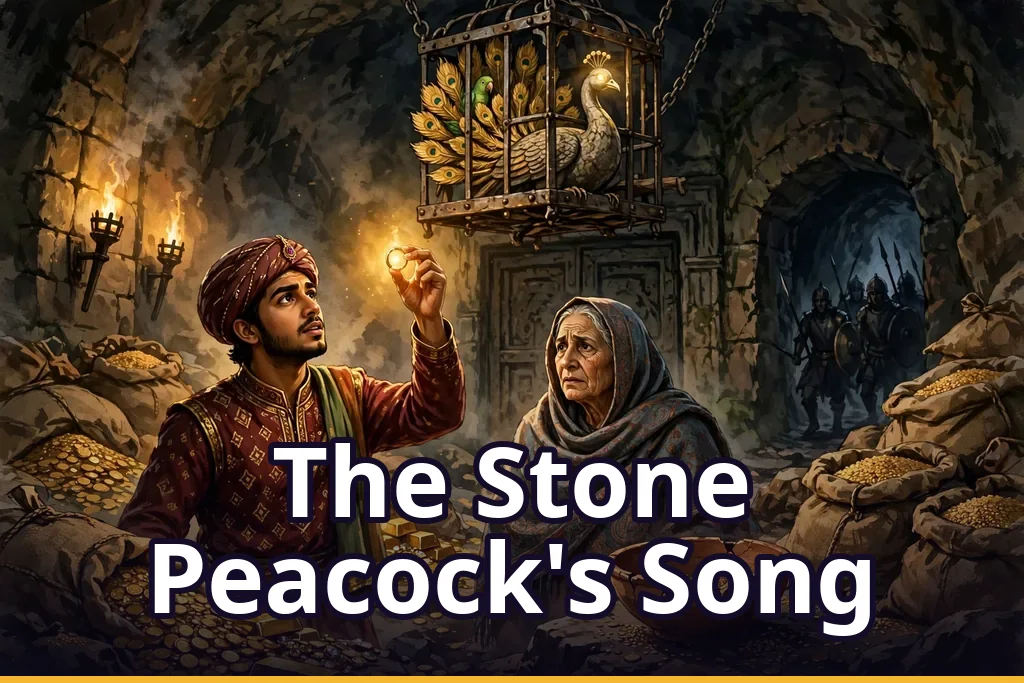
When the gate shut behind them, the darkness was so deep that Mehran could hear the sound of his own breath. In his heart he saw his father's face — the face of stone, standing in the darbar, as if the Sardar were still watching his son. Mehran pressed the pouch to his chest. Inside it were four pieces, and the fifth piece lay somewhere inside this very mountain. In his heart he said, “Abba, I have come.”
Sahil caught his arm. His voice was shaking. “Mehran, we are locked inside. The way out is shut. What will we do now?”
“We will go forward,” Mehran said quietly. “Ammi used to say that generosity is the greatest sword in trouble. This is that time.”
Sabz was hidden inside Sahil's turban. Very softly, he copied the sound of the bell, as if he too were afraid. Sahil at once put a finger to his beak. “Quiet, Sabz! Not now.”
Ahead, torches were burning. They reached a great hall where the tribute was being counted. An old keeper sat behind a huge book. His beard was white, his eyes were tired, and he was writing down everything in a long list. Soldiers were counting sacks, measuring cloth, and striking copper pots to test them. Every item was written under Qahhar Shah's name, as if the whole country belonged to him.
Kaka Rahim's wagon stood in front of them. A soldier counted the sacks and shook his head. “One sack short!” he said loudly. “Qahhar Shah wants it all. A short sack means the village must pay double. Otherwise the mule stays here.”
Kaka Rahim's hands began to tremble. Amina held her grandfather's hand. There were tears in her eyes, but she did not cry. Mehran remembered how that same child had broken her bread in half that morning and given it to her grandfather. Now, before her eyes, her grandfather's honour was in danger.
Sahil put his hand in his pocket. He took out a small silver coin. “Ammi put this coin in my pocket before the journey,” he whispered. “She said it was my good luck, and I must never waste it.” He looked at the coin for a moment, then looked at Mehran, and stepped quietly towards the keeper's table. He placed the coin at the edge of the book and bowed his head, like an ordinary labourer. “Sir, this will make up the missing sack.”
The keeper picked up the coin, held it to the light, and wrote something in the book. “Complete,” he said. The soldier let go of the mule. Kaka Rahim looked at Sahil. His eyes filled with tears. He said nothing, but his look was a prayer. Then, on purpose, he said to the soldier, “Sir, the wagon wheel has come loose again — please look at it!” The soldier turned angrily towards the wagon.
In that very moment Mehran saw the passage Kaka Rahim had told them about. Behind a pile of sacks, behind a curtain, there was a small low door. No soldier stood beside it. There was no lock on it. Mehran took Sahil's hand, and the two of them slipped quietly through the door. Sabz flew in after them.
Inside was the vault.
Mehran had never seen so much gold in his life. Heaps of gold, silver vessels, silk cloth, and sacks of grain — enough to feed a whole city for many months. But there was no light in that gold. Every piece had been seized from somebody's home. In one corner lay small children's toys. In another corner lay a bride's red shawl. Mehran's heart grew heavy. In his heart he said, “This is not treasure. These are people's tears.”
In one corner an old woman was sweeping the floor. Her name was Bibi Gul. A light chain lay around one ankle, and her lips were dry. When she saw Mehran, she grew frightened. “Who are you?” she whispered. “No one comes here, except the keeper.”
“We are labourers,” said Mehran. “We lost our way.” Then he saw that the old woman's hands were trembling. “Are you thirsty?”
Bibi Gul lowered her head shyly. “I have had no water since morning. The keeper says the vault's servants get water afterwards.”
Mehran still had a small water skin. Only a few mouthfuls of water were left in it. Sahil looked at him. Both of them were thirsty too, and the road ahead was long. Mehran thought for a moment. Then he held out the water skin to Bibi Gul. “You drink first,” he said.
Bibi Gul drank slowly, as if every drop were precious. Then she returned the skin and placed her hand on Mehran's head. “May God keep you safe, son. In this mountain, no one gives water to anyone.” Then she pointed towards a cracked clay bowl standing on a shelf. “Look there. Qahhar Shah thought one piece was worthless and threw it into that bowl. Among the heaps of gold, its shine was hidden. But I know that piece is not ordinary. Only someone who has given something today can touch it.”
Mehran picked up the bowl. Inside it lay a small piece, dull and grey, like an ordinary stone. Mehran took it in his hand. At first nothing happened. Then the piece began to grow warm. A golden light woke inside it, and it hummed with a soft sound, as if it were calling out to its four companions. Mehran opened the pouch. The four pieces began to shine too. All five pieces were together — for the first time.
“Mehran!” Sahil whispered joyfully. “All five are found!”
Mehran's eyes filled with tears. He pressed the piece to his chest. “Abba,” he said in his heart, “the ring is close to being whole again.”
At that very moment, a sound came from above the door of the vault.
A clear, soft, beautiful note. The Stone Peacock had begun to sing. Only one note, but so clear that the whole hall started. The keeper dropped his pen. The soldiers looked up. In the cage, the peacock moved its tail, and the old light woke in one of its eyes.
And then a crow came down from a beam in the roof.
The crow fell to the ground, and in the next moment Zaar was standing there. His eyes were cold, and there was a faint smile on his lips. “So the boy with four pieces has become the boy with five pieces,” he said. “Qahhar Shah has been waiting for you.”
The soldiers came running. In a single moment, Mehran made his choice. He held out the pouch towards Sabz and whispered, “Sabz — to the peacock! Quickly!” Sabz took the pouch in his beak and flew upwards. He hid behind the cage, among the folded feathers of the peacock's tail, where no one could see him.
The soldiers seized Mehran and Sahil. Their hands were tied. Mehran's sword was taken away. Zaar searched Mehran's pockets, shook out his cloak, and laughed. “Empty hands?” he said. “No matter. Qahhar Shah wants the boy. The pieces will be found later.”
Mehran was led towards a dark passage. Sahil walked behind him. Mehran looked back. In the cage, one of the peacock's eyes was open. Among its feathers, Sabz sat perfectly still and silent. The pouch was safe.
“Sahil,” Mehran whispered, “the game is not over yet.”
Then a heavy door shut behind them, and the bell tolled a third time — this time for Qahhar Shah.