Episode 12
The Thirteenth Chime
"CHOOSE YOUR INK."
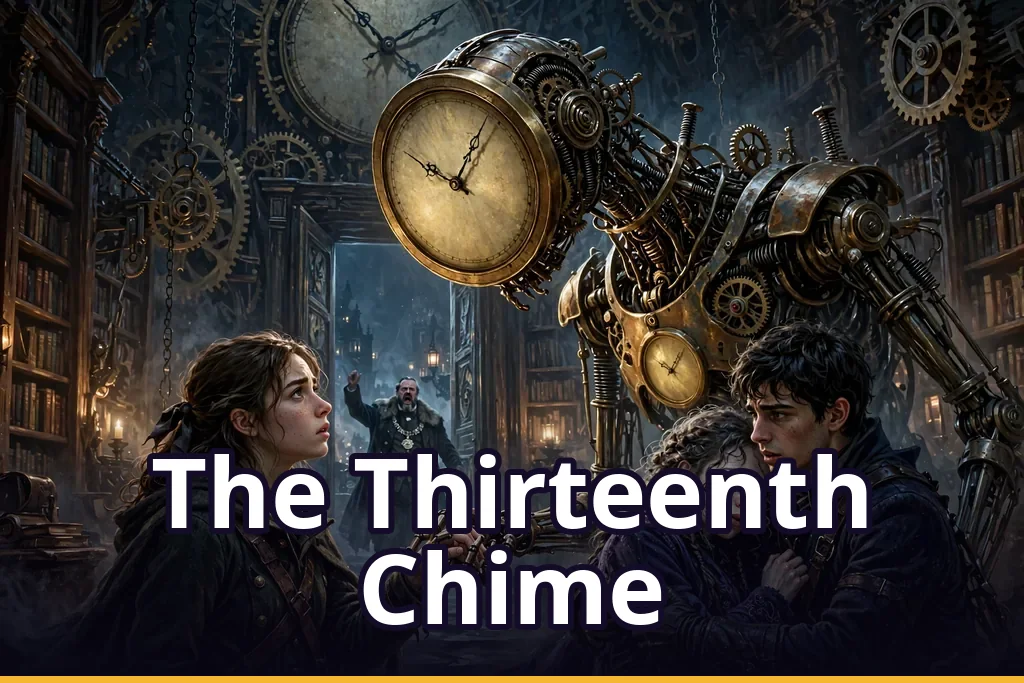
The Keeper lowered its terrible, tender clock-face toward Elena, and the great clock's hands crept toward midnight. Through the library's great doors, Mayor Hendricks was still shouting. Beside Elena, Zara swayed on her feet, Theo holding her up — Zara, who had taken the Keeper's hand, who was holding the name of the thirteenth hour alone while it fed on her minutes, one by one.
Elena held the brass key. It was warm — alive-warm, blood-warm. The pen. The oldest law, older than the Keeper's hunger: the Keeper-elect may write the first sentence of her keeping. One sentence. In ink. And ink, once written, the engine must keep.
The pen takes what the hand offers.
She thought of the other Elena — the draft — dissolving into dust and blank paper. "In my tomorrow, you chose the ink before the Keeper could choose it for you. You thought choosing made it noble. It didn't. It just made it yours."
The draft had paid with every memory of Rosa. The lavender shawl. The word piccola. A kitchen that smelled of rosemary. A hundred years of Marchetti becoming March. And in that tomorrow, Elena had turned from the engine and looked at an old woman in a lavender shawl — and felt nothing.
"Choose better than I did," said the dust.
Elena looked at Rosa — her Rosa, alive, crying silently, her shawl on the floor. She looked at Theo, at Zara, whose hand was trembling in his. She looked at the molten-gold book, where the sentence still burned:
"Tomorrow, one of the three friends will not come home."
And the name, forming: "T..."
Theo. Tomorrow, Theo would not come home.
"Elena, don't—" Theo started.
But Elena was already moving. She crossed to the engine — the great brass heart of the library, the thing that wrote tomorrow for the whole town every midnight — and she set the key's tip to the blank page the Keeper had laid out for her sentence.
"The Keeper's price is one precious memory per year," she said. Her voice shook, but it carried. "That's your law. But the midnight sentence is older than your hunger. And the pen takes what the hand offers."
"ELENA—" the Keeper began.
"I am not offering you a memory," Elena said. "I'm offering you something better. I'm giving your hunger a name."
Silence. Even the clock's creeping hands seemed to hesitate.
"A hunger with no name can never be fed," Elena said. "That's why you're starving. That's why you'll always be starving. A named hunger — a named hunger can sit at a table."
She bent over the page. The key moved like it had been waiting a hundred years for her hand.
She wrote, in ink, one sentence:
"Tomorrow, all three friends come home — and the Keeper's hunger is named Supper, and supper is shared."
The ink blazed gold. The engine shuddered — every gear, every spring, every blank book on every shelf trembling at once — because ink, once written, the engine must keep.
Across the library, the molten-gold book convulsed. Its sentence writhed, fought — and rewrote itself, letter by letter, in Elena's own handwriting:
"Tomorrow, all three friends come home."
The forming name — "T..." — dissolved like sugar in tea.
Zara gasped. The weight lifted off her all at once — the thirteenth hour, named now, ordinary now, just an hour like any other — and the name slipped from her grasp like a caught bird released. She sagged into Theo's arms, laughing and crying at once.
"THE PRICE—" the Keeper said, and its voice was different now. Smaller. "THE YEARLY PRICE—"
"Is supper," Elena said. "Named, and shared. My grandmother is alive, Keeper. She cooks. You will come to the table once a year, and you will be fed — real food, at a real table, with all of us. A guest, not a god."
The clock-face tilted. For the first time in a hundred years, the Keeper looked... uncertain.
"AND MIDNIGHT?" it asked.
"Strike it," Elena said. "It's yours to keep. That was always the bargain."
The Keeper raised its terrible tender face to the great clock. Its hands reached XII.
And struck.
Thirteen strokes — but the thirteenth was different. It didn't ring like a bell. It rang warm, low, golden — like a spoon tapped against a bowl, calling everyone to the table.
When it faded, the library was quiet. The blank books had turned their spines to the light, content. On the forty-eight steps, the draft's dust had settled — and where it settled, a real book now lay, bound in grey. Elena picked it up. On its spine, in pencil that would never erase:
"PENCIL, KEPT."
She shelved it between the histories, where it belonged.
Rosa was suddenly there, her arms around Elena, her lavender shawl around them both, and she was laughing through her tears. "Piccola," she whispered. "My clever, clever piccola."
"Did I choose better?" Elena whispered back.
"You chose supper," Rosa said. "There is no better choice."
The great doors burst open. Mayor Hendricks stood there, red-faced, mid-shout — and stopped. The library was calm. The three friends were standing. The old woman was smiling. Nothing was on fire, nobody was missing, and the whole vast room smelled, impossibly, of rosemary.
"What," the mayor demanded, "is going on in here?"
Elena turned. The brass key hung at her throat, cool now, quiet. Tag B-7. She was the Keeper. The first Keeper who had ever named the hunger's price herself — and made it supper.
"The library is closed, Mayor Hendricks," she said. "But come back tomorrow."
"Why?"
Elena smiled — her own crooked smile, nobody's copy.
"We're having supper."
That night, long after the town had gone back to sleep, Elena stood alone in the library and looked at the plaque by the door: BIBLIOTHECA HOROLOGII.
Beneath it, a new line had appeared in fresh gold:
"KEEPER: ELENA MARCH"
And beneath that, in pencil that would not erase, no matter how she rubbed:
"Choose better."
She left it there. Some sentences deserve to be kept.
At midnight, the engine wrote tomorrow — and for the first time in a hundred years, tomorrow began with the smell of rosemary soup. And if you listened closely, past the twelve strokes, you could hear a thirteenth chime — warm as a spoon against a bowl.
Only Elena could hear it.
It was, she decided, the sound of a hunger that finally had a name — and a seat at the table."