Episode 11
The Midnight Sentence
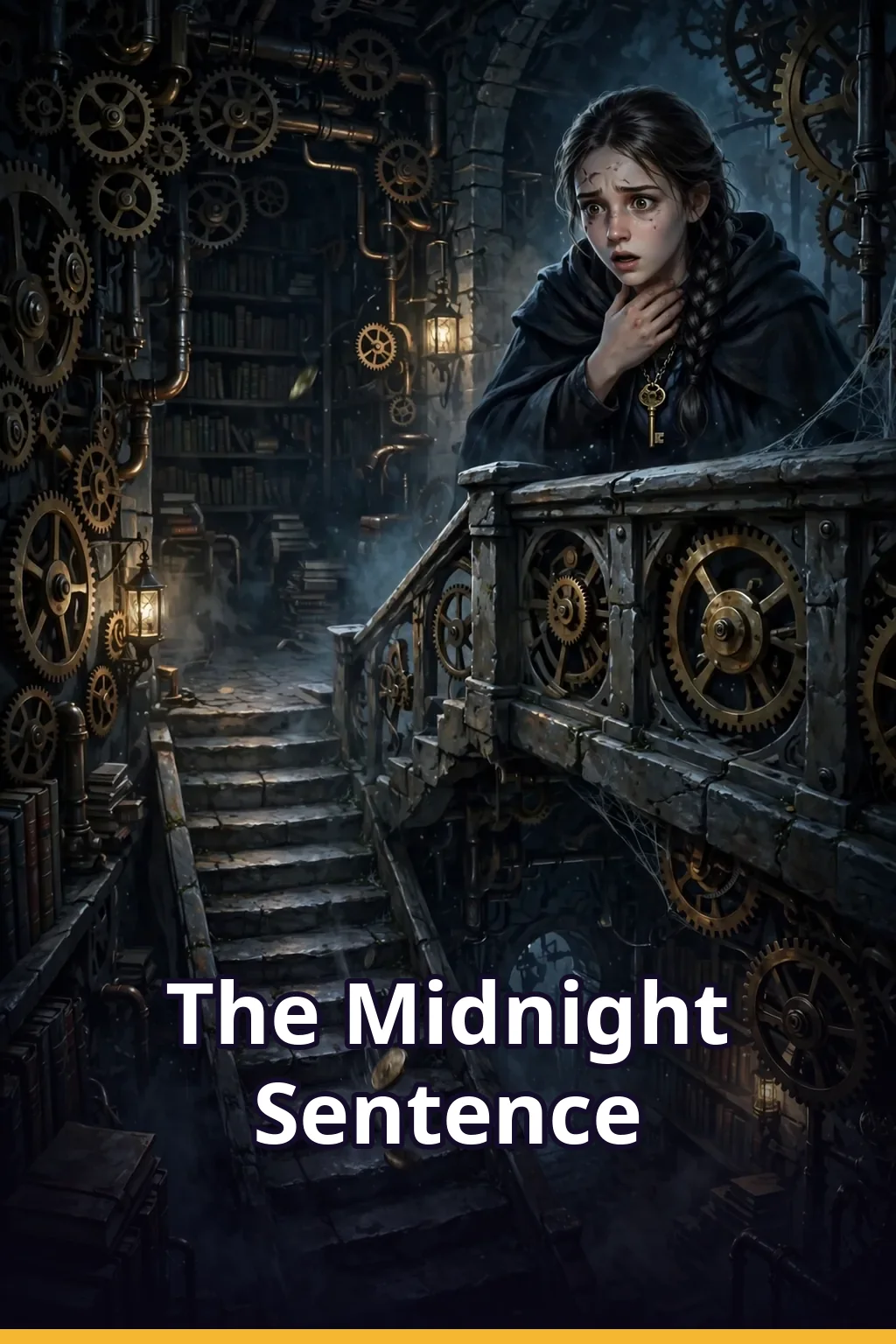
"Don't."
The word fell down the forty-eight steps like a dropped coin.
The girl on the landing was sixteen. She had Elena's face — Elena's exact face, down to the small scar on her left eyebrow from the summer of the broken swing. She wore Elena's dark braid over one shoulder. She wore the brass key at her throat.
Elena's hand flew to her own throat. Her key was still there, burning against her skin. Two keys. That was impossible. There had only ever been one.
"Who are you?" Theo said. He had moved in front of Zara without seeming to decide to, the way he always did when he was frightened.
"I'm you," the girl said to Elena, and smiled Elena's own crooked smile, and it was the worst thing Elena had ever seen on her own face. "Tomorrow. And if you speak that name together, the price doesn't divide."
Rosa made a sound like a teacup cracking. "Piccola — don't listen—"
"It multiplies," the other Elena said. "A name spoken by three is three names. The engine writes what is named — three times. Three hours, kept, every day, forever. One from each of you." She descended one step. Her feet made no sound on the stone. "The Keeper told you the price would divide. The Keeper is hungry. Hungry things lie."
"THE GIRL IS A DRAFT," the Keeper said. Its clock-face had turned toward the landing, hands frozen past XIII. "SHE IS PENCIL. SHE IS NOT INK. DO NOT HEED PENCIL."
"Pencil," the other Elena agreed. "That's right. Every midnight the engine writes tomorrow in ink — but first it drafts it in pencil. I'm the draft." She looked at Elena, and her terrible smile faltered. "I'm the Elena the engine drew for a tomorrow where the three of you speak the name together."
Zara's voice was thin. "What happens in that tomorrow?"
The other Elena touched her own temple, lightly, the way you touch a bruise. "I know I had a best friend named Zara. I know the words 'frog-sticker.' I don't know what they mean." She let her hand fall. "The Keeper took the whole memory from each of you. A friendship with no beginning doesn't survive the week. By Friday we were three strangers who kept almost remembering each other."
Silence. The blank books watched with white spines.
"Prove it," Theo said hoarsely. "Prove you're — whatever you say."
The other Elena lifted her key. The tag beside it caught the light.
B-7.
Elena stared at her own key. Her own tag. B-7.
"There has never been two," Rosa whispered. "In a hundred years. Never two."
"There aren't," the other Elena said gently. "One of these is written. Guess which."
Elena's throat closed. Her key was warm — alive-warm, blood-warm. The other girl's key hung cold and still as a coin.
"Why are you here?" Elena managed. "If you're only pencil —"
"Because pencil can be erased, and I don't want to be." The other Elena came down three more steps, and now Elena could see it — the faint translucence at her edges, like wet ink beginning to run. "Listen. There is a third way, and your grandmother is afraid to tell you, because the Keeper forbade her to teach it."
Rosa's face went white. "Basta—"
"Every midnight," the other Elena said, "the engine writes tomorrow for the whole town. In ink. And someone holds the pen." She looked at Rosa. "Tell her, Nonna. Tell her whose hand it is."
Rosa's lavender shawl had slipped to the floor. She did not pick it up. "The Keeper's," she said at last. "But by the oldest law — older than the hunger — the Keeper-elect may write the first sentence of her keeping. One sentence. In ink. And ink, once written, the engine must keep."
Elena's heart was hammering against the key. "I could write the unmaking. 'The thirteenth hour was never named.' Then Firstday was never spoken, Zara never took its hand, the taking never began—"
"Yes," Rosa said, and she was crying now, silently. "The draft burns. The ink holds. That is the third way. That is the way I was forbidden to teach you, because—" She stopped.
"Because the pen writes with memory," the other Elena finished. "And the writer chooses which memory becomes ink. The yearly price is the Keeper's to set — you learned that tonight. But the midnight sentence is older than the Keeper's hunger. The pen takes what the hand offers." Her voice softened. "That is why no Keeper teaches it, Elena. A Keeper who chooses her own price cannot be starved."
Theo had gone very still. "What's the catch?"
"The hour," Zara said quietly. She was pale, and her hand — the one that had taken the Keeper's hand — was trembling. "I have to hold the name until midnight. Alone. Don't I."
"Inside the named hour, midnight does not come on its own," Rosa said. "The Keeper must strike it."
"AND MIDNIGHT IS MINE TO KEEP," the Keeper said. "THE CLOCK STRIKES WHEN I SAY."
A sound came through the library's great doors then — muffled, furious pounding, and a man's voice shouting. Mayor Hendricks. Of course. The town had felt the first taking — the thirteen strokes, the missing minutes. Somewhere below, a bus driver had missed his turn. Somewhere, a mother had looked at her daughter and forgotten her name. The town was awake, and it was afraid, and it wanted answers.
"You see my terms, little Keeper," the Keeper said, almost tenderly. "THE GIRL HOLDS THE NAME UNTIL I STRIKE. EVERY MINUTE SHE HOLDS IT ALONE, THE HOUR FEEDS. NAME YOUR INK — SPEAK ALOUD THE MEMORY YOU WILL PAY — AND I WILL STRIKE MIDNIGHT."
"No," Theo said. "No, that's— Elena, don't—"
But Elena was looking at the other Elena, who was looking at her own hands, where the edges were coming undone now, dissolving into dust and blank paper.
"It's starting," the other Elena said. "You're choosing a new tomorrow. The draft is unwriting." She reached into her jacket — Elena's jacket, the one with the torn pocket — and drew out a folded page. "Pencil rewrites itself before it goes. Take it. Look at what you're writing toward."
Elena took the page. It was warm. Words were moving across it in molten gold, rearranging themselves even as she watched — and then they settled, and Elena saw herself: standing at the engine at midnight, the brass key in her hand like a pen, writing one sentence into tomorrow.
And she saw the ink.
It was draining out of the page in a thin gold stream — every memory of Rosa. The lavender shawl. The word piccola. A kitchen that smelled of rosemary. A hundred years of Marchetti becoming March. All of it, flowing out of Elena and into the sentence.
In the draft, tomorrow's Elena turned from the engine and looked at an old woman in a lavender shawl — and felt nothing. Politely smiled at a stranger.
"I know I had a grandmother," the other Elena whispered. "I know I paid her. I can't remember her face."
Elena's hands were shaking so hard the page rattled.
"In my tomorrow," the other Elena said, "you chose the ink before the Keeper could choose it for you. You thought choosing made it noble." What was left of her smiled Elena's crooked smile one last time. "It didn't. It just made it yours."
She came apart like wet paper in rain — into dust, into blank pages that drifted down the forty-eight steps and settled among the blank books, indistinguishable.
"Choose better than I did," said the dust.
Silence.
Then the Keeper lowered its terrible tender face toward Elena, and the great clock's hands began, slowly, to creep.
"MIDNIGHT APPROACHES, LITTLE KEEPER," the Keeper said. "THE GIRL WEAKENS. THE TOWN WAITS."
Through the doors, Mayor Hendricks was still shouting.
Zara swayed on her feet, and Theo caught her.
"CHOOSE YOUR INK."