Episode 9
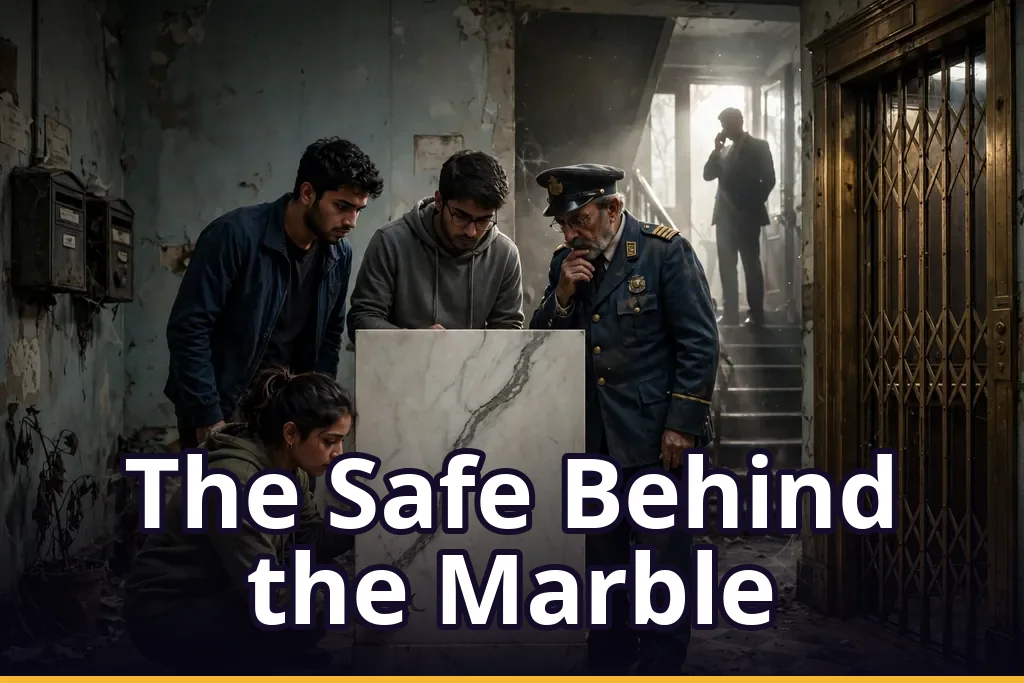
The Safe Behind the Marble
Omar did not sleep. He sat on the cold stair between the eighth and ninth floors until the sky over Karachi turned the colour of weak tea, listening to the building breathe. Every few minutes he took out his phone and looked at the one contact that mattered. It had once read Abbu, with a number and a photograph of his father laughing beside the old lift. Now there was no number and no photograph. Only a single letter remained, thin and stubborn, like the last coal in a fire that refused to go out.
Below, Rafiq Chacha was already at his post, humming his tuneless song and polishing the brass gate as if shine could hold a memory in place. Twice in the night Omar had gone down with tea. Twice his father had smiled at him the way a kind man smiles at a neighbour's son, and asked what his name was. Twice Omar had answered, and watched the name settle for a little while, like a bird landing, and then lift off again.
"I am still here, Abbu," Omar whispered. "Even if the paper says I am not."
Upstairs, Maha had not slept either. She sketched the lobby from memory until the lines blurred. She had been right about the rules — a filed record torn out of 2001 could have unravelled far more than one lie. But rightness felt very small beside the look on Omar's face when his father asked him his name. Dadi Sakeena watched her from the doorway.
"Being right is not the same as being kind," Dadi said. "You held his hand back in 2001. Now go and hold it properly. Say the thing that matters. Not the rule. The sorry."
"What if he still goes back alone?" Maha asked.
"Then he will go knowing someone came after him," Dadi said. "Go."
---
The drills started at first light. The tower shuddered, dust sifted down, and the lights fluttered — once, twice — the way they always fluttered before the lift did something impossible.
Omar was already in the lobby, hand raised toward the call button. He had told himself all night that he would not wait for permission. One more trip. One more minute with the clerk. This time no bell, no rule, and no Maha would decide for him.
"Omar."
He did not turn. "Don't, Maha. Not the rules. Please."
"No rules," Maha said, coming to stand beside him, not between him and the lift. "I came to say I was wrong. Not about the danger. About you. In 2001 I was protecting history, and I forgot to protect my friend standing beside me. Your father is not a rule, Omar. He is your Abbu. I am sorry I made you feel as if he mattered less than a piece of paper."
Omar's hand stayed raised for a long moment. Then it fell. The lights steadied. The lift did not open, and neither of them called it.
"I was going to go alone," he said.
"I know," Maha said. "I am glad you waited long enough for me to catch up."
Tara came down the stairs two at a time, breathless, clutching a folder. "Neither of you is going anywhere," she said. "Not until you see what I found. I could not sleep, so I did what I always do. I stared at the photograph until it stared back."
---
It was the old photograph from the maintenance shaft: Mr. D'Mello in 1972, kneeling in the lobby, hiding the tin box. They had studied it a dozen times — the box, his hands, his face. Tara had looked somewhere else.
"Behind him," she said, spreading enlarged prints across the reception counter. "Not the box. The wall."
In the enlargement, the wall behind D'Mello was pale marble, cut by one dark vein that curved like a river. In the polished stone, faint as breath on glass, was a reflection: a round dial, with numbers, set into something dark and square. Near the bottom, almost lost in shadow, was a small mark cut into the marble — a crescent, no bigger than a thumbnail.
"A safe," Tara said. "He was not hiding the box in a hole in the wall. He was putting it inside the old hotel safe. And the safe is still here. Look."
She pointed at the present-day lobby wall beside the lift — the great panel of pale marble every resident walked past without seeing. One dark vein curved through it like a river. Maha crouched and wiped grime from the skirting with her sleeve.
There it was. The crescent. The same mark, in the same stone.
"It is the same wall," Maha breathed. "The safe was never moved. It was bricked up behind this marble, and the marble stayed."
Dadi came down in the lift, leaning on her stick, and looked at the panel for a long time. Recognition and distance crossed her face at once, like a woman looking at a house she lived in long ago.
"After the fire, marble men came to repair the lobby," she said slowly. "I brought them chai. One said this wall would keep secrets better than any lock." She pressed her palm to the cold stone. "I remember the chai. I remember his hands, white with dust. I do not remember what is behind it. That part is still gone."
Maha put her arm around her. "You do not have to remember, Dadi. The photograph remembered for you."
Omar knocked gently, listening the way his father had taught him to listen to pipes. The sound came back hollow in one place and solid everywhere else — a door behind a wall, waiting.
"We open it now," Omar said. "A hammer, a chisel —"
"No," Tara said firmly. "Not like thieves in our own lobby, with Qureshi's drill crew one floor away. If we crack the marble wrong, we could crack what is inside. The deed must be opened in front of the cooperative, with witnesses, or Qureshi will call it a forgery. We do this properly. Dadi, the committee, daylight, a proper mason. Tomorrow."
"Tomorrow," Omar repeated, and the word sounded like both a promise and a weight.
---
They checked the register together, because hope needs a witness too. The line was still gone. The brass plate beside the lift was still blank. Nothing had been magically repaired while they slept. The doubt planted in 2001 had not yet grown into a correction. It might never. But it was planted.
Then Rafiq Chacha came over with his cloth, looked at Omar, and said, without being asked and without searching for it: "Omar, beta. Your chai is getting cold."
Omar froze. The name, spoken unprompted, in his father's own voice, as if it had always belonged there.
"Abbu," Omar said, his voice breaking open. "You remembered."
"Paper forgets," Rafiq said, repeating Dadi's words as if he had carried them all night. "A heart holds on longer." He patted Omar's shoulder, and for the first time since the ripple, Omar felt known — not explained to, not reminded, but known. Maha turned away so they would not see her crying.
"We found where the box is, Abbu," Omar said quietly. "Behind the marble. We are going to bring it home."
"Then we will wait together," Rafiq said. "A liftman learns to wait."
For a little while the three friends stood in the lobby as they used to stand, shoulder to shoulder, morning light coming through the doors and sea smell drifting in. Maha sketched the crescent mark, Tara photographed the vein in the marble, and Omar stayed close to his father, as if closeness itself were a kind of remembering.
It was Tara who heard it first. A click, small and sharp, from the stairwell — the sound a phone camera makes when it is trying very hard not to be heard.
They turned.
Shahbaz Qureshi stood on the third step, in a suit too clean for a building site, holding his phone very still, smiling the smile of a man who has just been handed a map.
"Thank you," he said pleasantly, looking not at them but at the marble panel. "I have been wondering for weeks where Mr. D'Mello kept his little safe. You have saved me a great deal of drilling."
Behind him, the drills stopped, one by one, as if the building were holding its breath. The lights fluttered. Above them, the old lift gave a low, patient ding — and Omar, Maha and Tara understood, all at once, that the race for the safe had just begun, and Qureshi was no longer hunting in the dark.