Episode 8
Eleven Minutes in 2001
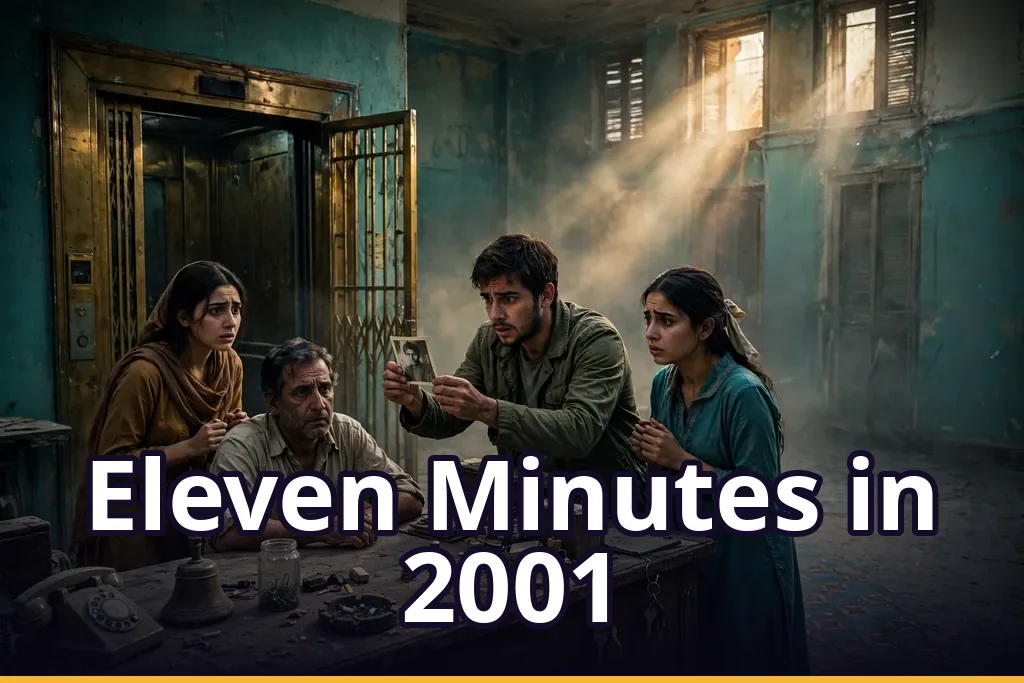
The hesitation lasted only a second. It felt like a lifetime.
Rafiq Chacha turned toward his son, searching Omar's face the way a man searches a dark room for a door he knows is there. For one terrible moment, it seemed he would not find what he was reaching for.
Then Omar said it himself, quietly. "It's me, Abbu. Omar."
"Omar," Rafiq said, slowly, and then with sudden warmth: "Omar. My son." He squeezed Omar's shoulder, and the relief that went through Omar was so sharp it almost hurt.
But Rafiq's gaze moved to the little brass plate beside the lift doors. It had read LIFTMAN: RAFIQ for as long as Omar could remember. Now it was blank. Rafiq traced the empty space, frowning.
"I know I worked here," he said. "I can hear the lift. I can smell the oil. But the year I started... it slips, beta. Like a coin through a hole in a pocket."
The register was still blank. The staff photograph was still missing its caption. On Omar's phone, his father's contact still showed only the word Abbu, with no number and no photograph. The living man remembered his son when his son spoke his name aloud. The building, and everything written in it, did not.
Dadi Sakeena came down in the lift, leaning on her stick, and understood everything at one look. She put her hand over Rafiq's on the blank plate.
"Paper forgets," she said. "A heart does not forget so easily. Hold on to that, Rafiq. Hold on hard."
---
Upstairs, in Dadi's flat, they faced the choice Qureshi had left them.
"We accept his deal," Omar said. "We stop hunting for D'Mello's box. The tidying stops. My father keeps his name."
"And then what?" Maha said. "Qureshi knocks the building down. Every family loses its home. The deed is the only proof that this land belongs to the cooperative. If we stop looking, we hand him everything — and what stops him tidying the rest of us afterwards?"
"He promised fair payment," Omar said.
"He promised," Tara said quietly. "Men like Qureshi keep promises the way the sea keeps sandcastles. A deal that buys one man's memory by selling thirty families' homes is not a deal. It is a ransom."
"Then tell me another way," Omar said. "Talking is not bringing his name back."
Tara took out a print of the photograph she had taken of the register page last month. In faded blue ink, the line was still there: Rafiq Farooqi, liftman, employed since 1972.
"We go back to where it was changed," she said. "To 2001, to the clerk Javed lied to. We show him the truth. A photograph is small. Small things slip through the lift. If the clerk sees his own book was wrong, he corrects it himself — and the ripple runs the other way."
"A correction, not a theft," Maha said. "Rule three. A big change erases a person. A small, true correction should only undo a lie."
"This trip is only for Rafiq's name," she added. "We touch nothing else in 2001. We stay away from the liftman's station — Rafiq himself is working there in 2001. We show the clerk the photograph, let him decide, and come home when the bell rings. Agreed?"
Omar nodded. But his eyes were already on the door, and Maha saw that he had agreed to the words, not to the patience they required.
---
The drills started again just after noon. The lights fluttered — once, twice — and the three of them were already standing at the lobby, where the rules said the lift must be called from. Maha pressed the call button. The old lift arrived, and the lobby clock above the doors showed the minute hand just past twelve. They had until it came all the way around.
"2001," Maha whispered, as the doors closed.
The lift shuddered and opened on dust, shouting, and the smell of fresh paint. The Marina lobby in 2001 was half hotel and half building site, with a hand-painted sign: CONVERSION OFFICE. The wall clock ticked loudly. Eleven minutes. No more.
"Stay away from the liftman's corner," Maha hissed, as a distant humming reached them — a younger man's voice, tuneless, familiar. "That is him. We do not speak to him."
The conversion clerk, Mr. Saleem, sat in a small side office with a ledger open on his desk. He looked up, annoyed. "Who are you? This office is not open to residents' children."
"Please, uncle," Tara said, laying the photograph on his desk gently, as if it could break. "There is an error in your staff record. This man — Rafiq Farooqi — worked here. He was the liftman. Someone told you otherwise, and it was not true."
"Children do not bring old photographs into my office," Mr. Saleem said. "Who sent you?"
"Your book is wrong," Omar said, his voice rising. "Fix it. Write his name back in."
Then Omar saw it: pinned to the noticeboard, a small correction slip in unfamiliar handwriting. CORRECTED: no liftman by the name of Rafiq Farooqi was ever employed at this establishment. Javed's work. The lie, made into paper.
"There," Omar said, reaching for it. "That is the lie. I will take it down and it will be over."
Maha caught his wrist. "Omar, no. That slip is filed. If you tear a filed record out of this office, that is not one line. That is a missing page. Rule three — a big change, and someone is forgotten. What if you erase more than Javed did?"
"What if I do nothing and my father forgets me?" Omar shouted.
"Please," Maha said to the clerk, forcing Omar's hand down. "Compare the handwriting on that slip with your own. The ink is different. The hand is not yours. Someone told you a story, and you wrote it down because it sounded like a correction."
Mr. Saleem frowned. He picked up the slip, looked at the photograph, looked at the slip again. For one bright moment, doubt crossed his face like cloud shadow crossing a field.
Then the brass bell dinged, and the lobby clock's minute hand completed its round.
"We have to go," Tara cried. "Now, Omar — now!"
"Fix it," Omar begged. "Please. He is my father."
They ran. Maha held the closing doors, and they tumbled inside as the lift rose back toward their own year.
In their own lobby, Tara's photograph still showed the line — Rafiq Farooqi, in faded blue ink — but only just, as if someone had breathed on it. Omar's pockets were empty. He had taken nothing at all.
They opened the register on the reception counter, holding their breath.
The line was still gone.
---
"You held me back," Omar said, quietly, which was worse than shouting. "The clerk was doubting. One more minute and he would have torn that slip up himself."
"I held you back from tearing a filed record out of history," Maha said, shaking. "The ripple could have taken the clerk, the conversion, half the building's memory. I was protecting all of us."
"You were protecting your rules," Omar said. "While my father forgets my name."
"We planted doubt," Tara said, stepping between them. "Doubt travels too. The clerk may still act —"
"May," Omar said bitterly. "May is not a name in a book." He picked up his delivery bag. "Tomorrow, when the drills shake the building again, I am going back. Alone."
He walked out into the Karachi evening and did not look back. The three friends were not on the same side of the door. Dadi watched from the top of the stairs and said nothing, which frightened Maha more than shouting would have.
---
Much later, when the building had gone quiet, Omar came back, because he could not stay away. Rafiq Chacha was still at the lift, polishing the brass gate, humming his tuneless song.
He turned, and smiled politely, the way a kind man smiles at a familiar face he cannot quite place.
"Beta," he said. "You look familiar. Have we —" He stopped, his smile faltering. "Forgive me. I know I should know this. What is your name?"
Omar stood very still. In his pocket, his phone buzzed once. He did not need to look. The contact that had read Abbu since he first owned a phone was thinning, letter by letter, and now only a single letter remained.
"My name is Omar," he whispered. "Abbu. I am your son."
Rafiq repeated it slowly, holding on to it the way a drowning man holds on to a rope. "Omar," he said. "Omar."
But his eyes, when he looked at the blank brass plate beside the doors, were the eyes of a man looking at a door he had walked through all his life — and could no longer remember what was on the other side.