Episode 7
The Name That Vanished
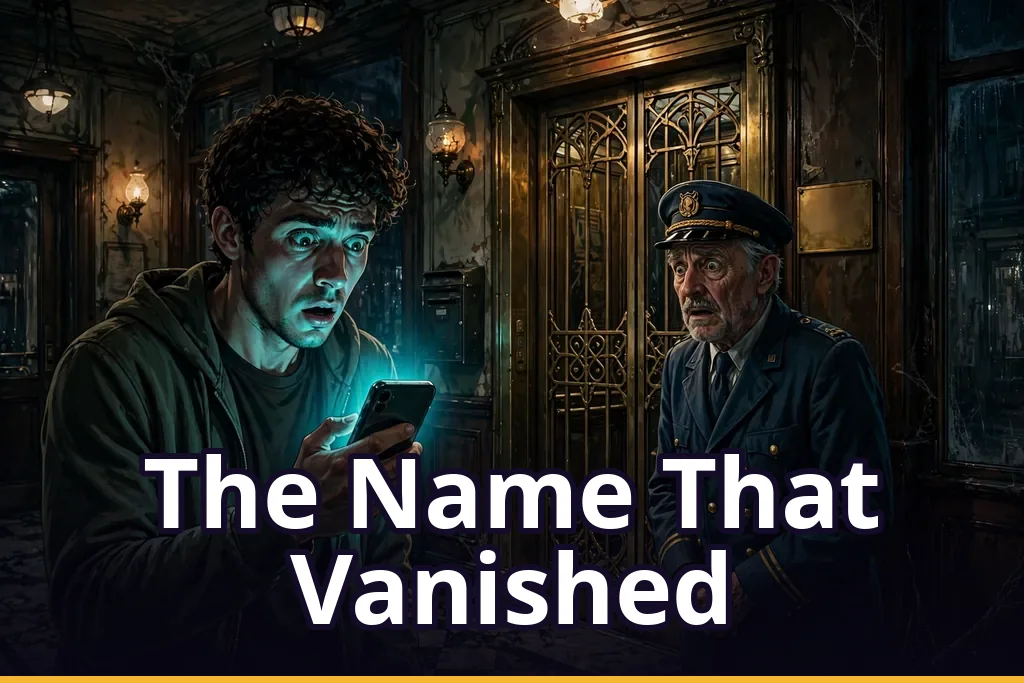
The morning after Javed Anwar's smile, Maha found Omar standing in the lobby with the building register open on the reception counter, staring at a page the way you stare at a door you have walked through all your life and suddenly find bricked up.
"Omar?" she said.
He did not look up. "Abbu's name," he said. "It was here. On the staff roll. Rafiq Farooqi, liftman, employed since 1972. I have seen it a hundred times. Tara, you photographed this page last month for the archive."
Tara was already scrolling through her phone. She found the photograph, held it up beside the open book — and went quiet. In her photograph, the line was there, in faded blue ink: Rafiq Farooqi. In the book on the counter, the same line was gone. Not crossed out. Not smudged. Gone, the way a footprint is gone from sand after the tide has come in, leaving the rest of the page perfectly undisturbed.
Down the corridor, the old framed staff photograph still hung on the wall — forty men in hotel uniform, arranged in rows on the steps of the Marina in 1972. Under it, the brass caption plate listed their names. Maha ran her finger along the plate to the place where Rafiq's name should have been. It was smooth there. Blank.
"This is not an accident," Maha whispered. "This is a ripple."
---
They found Javed Anwar at the chai dhaba below the tower, sitting in the shade with a cup in front of him, as relaxed as a man waiting for a bus he already knows is coming.
"You did this," Omar said. His voice shook, and he hated that it shook. "You went down in the lift and you changed something."
Javed did not bother to deny it. He stirred his chai slowly. "I did what my employer asked, nothing more. During the drilling yesterday, the lights flickered — your famous fluctuation — and I called the lift from the lobby, the way the rules demand." He smiled, thin as a wire. "I rode to 2001, the year your building stopped being a hotel and became flats. And I spoke to the conversion clerk. I told him there had been an error in the staff record — that no liftman by the name of Rafiq Farooqi had ever worked at the Marina. A small correction. One line. The clerk believed me. He had no reason not to."
"One line," Omar repeated.
"One line," Javed said. "And now, in your present, your father's name is quietly leaving the building. First the register. Then the photographs. Then —" He shrugged, as if the rest were too boring to say. "That is how ripples work, is it not? Small change, small ripple. But ripples travel, children. They do not ask permission."
Maha's hands curled into fists at her sides. "Why? What does Qureshi gain from erasing a liftman?"
"Leverage," Javed said simply. "Mr. Qureshi wants you to understand what his reach is. He can tidy history the way other men tidy a room. Today it is a name in a book. Tomorrow it could be a name on a lease. A name on a deed." He stood, set his cup down with a soft click, and added, almost kindly, "Stop looking for the box, and the tidying stops."
---
Rafiq Chacha was oiling the lift gate when they came back upstairs, humming tunelessly. Maha watched him for a moment before she could speak, and what frightened her most was how ordinary he looked — the same stooped shoulders, the same oil-can, the same patient hands on the brass.
"Chacha," Omar said, and his voice cracked open. "Do you remember — do you remember when you started here?"
Rafiq looked at his son, and for one terrible second, his eyes went vague, the way a man's eyes go when he is trying to remember a song whose words have slipped. Then he smiled, and the vagueness passed. "1972, beta. The opening night. I carried the guests' suitcases up in this very lift. Your mother used to say I married the lift before I married her." He laughed, and the laugh was entirely his own. "Why do you ask?"
Omar swallowed. "No reason, Abbu. Just — just checking."
But when Rafiq turned back to the gate, Maha saw it: his hand hesitated over the brass plate beside the lift doors, the little plate that had read LIFTMAN: RAFIQ for as long as she could remember. The plate was blank now. And Rafiq's fingers traced the empty space, slowly, the way a man traces a scar he cannot remember getting.
Tara pulled Maha aside, her voice low and furious. "The ripple is still moving. If Javed's lie stands, it won't stop at a register. What happens to a man the building forgets?"
"Rule three," Maha said, and the words tasted like ash. "A big change, and someone in the present is forgotten. Javed thinks he made a small change. But a man's whole working life is not small."
---
That evening, Shahbaz Qureshi came to Marina Heights himself.
He did not come with drills or lawyers. He came in a white shalwar kameez, polished shoes, and a smile that had been practised in a hundred boardrooms, and he asked the watchman, very politely, to see the young people who had been asking questions about the building's history.
"Miss Siddiqui," he said, shaking Maha's hand as if they were meeting at a wedding. "I admire what you are doing. Truly. A young woman fighting for her home — it is a story anyone would admire." His eyes moved to Omar, to Tara, to the old lift behind them. "But I must be honest with you. I have seen what your lift can do. My man has ridden it. And I have learned something you may not have: whoever holds the past holds the paperwork."
From his pocket he drew the brass key — warm, old, unmistakable — and held it up between two fingers. "Do you know what this opens? Not a door. Not a safe." He nodded toward the lift. "It opens the lift's own brass panel. The panel your liftman has tended for forty years. With it, a man can hold the lift where he wants it, for as long as he needs, during a fluctuation. That is how my man rode without your liftman's blessing. And that is how, when the drills shake this building again, I will ride it myself."
Maha felt the lobby tilt slightly under her feet. "You can't," she said. "The lift has rules."
"Rules," Qureshi said gently, "are for people who have never owned the building the rules are written in." He slipped the key back into his pocket. "I am not a cruel man, Miss Siddiqui. I will make you one offer, and it will stand until the next fluctuation: stop hunting for D'Mello's box. Let the demolition proceed, and every resident will be paid fairly and housed well. Refuse — and my man will keep tidying. One line at a time. And we will see how much of your building's memory is left when the drills finish."
He left the way he had come, unhurried, through the lobby doors into the Karachi evening.
---
They stood in the lobby long after he had gone, the three of them and the old lift, and nobody spoke.
Then the lobby lights fluttered — once, twice — and the brass bell gave its small, polite ding.
No one had touched the call button. But the lift was awake anyway, the way it had been awake the night Javed stepped out of it, and Maha understood, with a coldness spreading from her stomach outward, that the brass key had changed the bargain: the lift would answer to whoever held it now, rules or no rules.
And then Omar, who had been staring at his phone, made a sound like someone who has been struck without warning.
"Maha," he whispered. "Look."
On his screen, his father's contact — Abbu, saved with a little lift emoji beside it for as long as he had owned a phone — was fading. The name was thinning at the edges, letter by letter, the way ink thins when paper gets wet. And under it, where his father's number had always been, there was only a blank, waiting space.
Omar looked up at his father, who stood by the lift gate, oil-can in hand, frowning at the blank brass plate as if it were a question he had been asked before and could no longer quite remember the answer to.
"Abbu," Omar said, very quietly. "Do you remember my name?"
Rafiq Chacha turned toward his son — and hesitated. Just for a second. Just long enough.