Episode 4
Dada's Last Letter
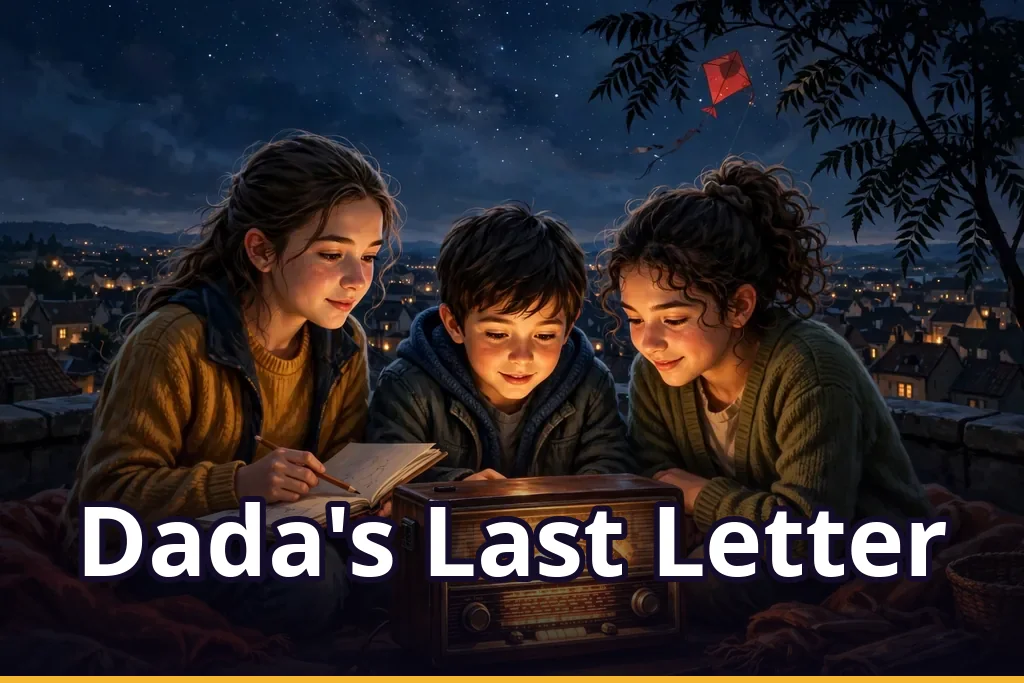
On the morning of day four, the mosque courtyard was crowded.
The night's bulletin had come true: a red kite was tangled in the highest branch of the neem tree, and the whole neighbourhood had gathered to bring it down.
“I'll climb!” said Danish — the watchman Iqbal's son, Hashir's best friend. He wrapped himself around the trunk and shimmied up like a monkey. Below, everyone held their breath.
“Careful!” Mahnoor shouted.
Danish shook the branch. The kite tore free — fluttered in the air for a heartbeat — and then dropped neatly into a small child's waiting hands. Applause broke out across the courtyard. Danish slid down, his shirt torn at the elbow, sweat on his forehead, triumph on his face.
“This kite is mine now!” he announced.
“No!” the little ones yelled. “It belongs to the lane!”
Hashir glanced at Mahnoor and whispered, “See? The radio said it — the whole neighbourhood would gather. Word for word.”
Mahnoor wrote in her notebook: *Third headline — true. Red kite, neem tree, the whole neighbourhood.*
But the second headline was ringing in their heads: *This evening, a stranger will knock on this house's door — and ask: “Is Kareem Sahab in?”*
At noon the sky clouded over without warning.
At Malik Bashir's house the wedding feast was already laid out in the open courtyard — but above it now stretched a great canopy, the very one ordered at Mahnoor's suggestion.
Then the rain came — as if the sky had overturned a bucket.
The guests huddled under the canopy. The food stayed dry. Nobody got soaked. And when the rain stopped, Fahad's mother wrapped Mahnoor in a hug.
“Child, you saved our honour today!” she said. “Rain in this heat — who could have imagined it!”
Zoya nudged Hashir with her elbow. “Strategy, hmm?”
Hashir nodded proudly, but his eyes were on the sky. “News can be bent,” he said quietly. “But news never lies.”
Mahnoor wrote: *First headline — true, but bent. The rain came, but it harmed nothing.*
In the evening — just as the call to Maghrib prayer floated through the air — there was a knock on their door.
The three of them stared at each other. Ammi moved to open it, but Mahnoor got there first.
On the doorstep stood an old man — a white beard, trembling hands, an old leather bag in his grip. His eyes swept the courtyard, then stopped — on the radio, sitting on top of the shelf.
“Is… Kareem Sahab in?” he asked.
Silence fell.
“Dada Abu… he…” Hashir began, but Mahnoor squeezed his hand.
“Please come in,” said Mahnoor. “Who are you?”
“My name is Sattar,” the old man said, sitting down. “Muhammad Sattar. I… I worked with Kareem at the radio station. Forty years. He read the news; I fixed the machines.”
Dadi appeared in her room's doorway. Her face had gone pale.
Sattar Sahab opened the bag and took out an envelope — yellowed, sealed, never opened.
“This letter…” His voice shook. “This is Kareem's last letter. He gave it to me the night before he passed. He said — Sattar, this is my last message, put it on the air.”
“Then why was it never broadcast?” asked Zoya.
Sattar Sahab lowered his gaze. “A new manager had come. He said — a personal message is not news. And I… I didn't have the courage. I kept the letter. All these years, every night, I've thought about how I buried my best friend's last message.”
He held the envelope out to Dadi. “Then I heard — the lanes are whispering that in Gali Number Chaar, some radio speaks at midnight. I understood. He… he is calling. This letter belongs to him.”
Dadi took the envelope with trembling hands. She broke the seal. She drew out the letter — in Dada Abu's crooked handwriting.
Mahnoor read over Dadi's shoulder, slowly, aloud:
*“My dear listeners,*
*A newsreader is one who tells you what happened. But in forty years I have learned that the truest news is the kind that hasn't happened yet — the hope you carry in your heart for someone.*
*This radio I joined with my own hands — from old spare parts, with Sattar's help. People laughed: who would listen to such an ancient box? But I knew: a radio built with love remembers voices.*
*Sattar, if you are reading this, I will be gone. Let this radio stay in my house. And tell my wife…”*
The letter ended there — half a sentence, the ink trailing off.
Tears ran down Dadi's cheeks. She pressed the letter to her chest.
“That night,” Sattar Sahab said softly, “he told me one more thing. There was a stormy night once; the whole staff ran home, but Kareem sat before the microphone and kept reading the news. He said: ‘The news must not stop.’ He believed that news… news protects people.”
The room was quiet. Then Dadi — after all those years of silence — spoke aloud for the first time:
“When the city falls asleep, the radio will speak.”
The three of them looked at her. There were tears in Dadi's eyes, but a faint smile on her lips.
“That is what he said on his last night,” said Dadi. “I thought it was the fever talking. But… this is what he meant.”
Mahnoor wrote in her notebook, her hand shaking: *Dadi spoke. “When the city falls asleep, the radio will speak.” — those were Dada's last words.*
When Sattar Sahab rose to leave, Dadi took his hand. “The letter arrived,” she said. “Late — but it arrived.”
At night the three were on the roof. The radio sat between them — the empty box with only one name inside it. But the name no longer felt empty to them.
At exactly twelve — the voice came.
“Tomorrow's news.
First: tomorrow morning, that same red kite — the one freed today — will catch on the school's flagpole, and the headmaster will hoist a white flag beneath it.
[a soft bell rang]
Second: tomorrow afternoon, the postman will bring a letter to Iqbal the watchman's house — the decision on his son Danish's scholarship. The whole lane will say the letter went to the wrong hands. Do not stop it.
Third: tomorrow night, an old generator at the grid station will hum for one hour — but the town's lights will not come on.”
Silence.
Hashir's face had gone white. “Danish…” he whispered. “Our Danish. The watchman's son. A scholarship letter… and the lane will say it went to the wrong hands…”
“The bell,” said Zoya. “It rang before that headline. That means — this is the one we must not stop. Whatever happens.”
Mahnoor wrote down all three headlines. Then she drew a line under the bell-marked one and wrote:
*RULE: never stop a bell-marked headline — even if it looks like a disaster.*
Then — a sound on the stairs.
Dadi stood in the roof doorway. She had heard everything. Her face — which had smiled for the first time that evening — was pale again.
She looked at Mahnoor, and said very softly:
“Don't tell Danish's mother.”