Episode 11
The Empty Chair
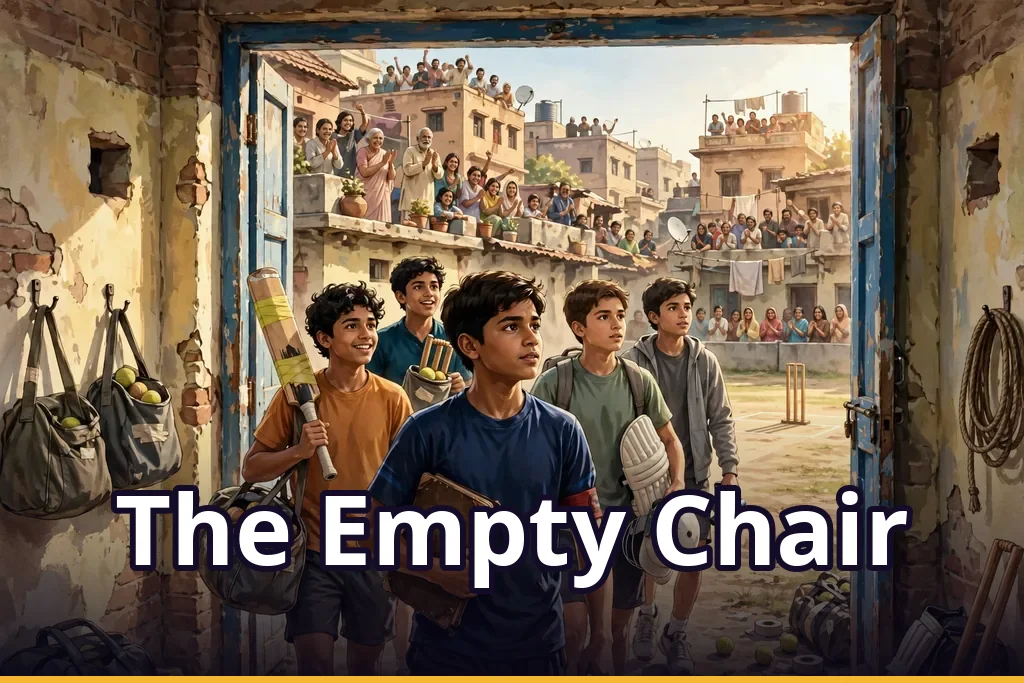
The sound of the black car's engine faded slowly down the street, and then the lane fell silent. Inside Coach Rana Iqbal's house, the old scorebook lay closed on the table. Waleed kept Mamu Sikandar's handwritten betting slip safe in his pocket, as if it were not a scrap of paper at all but the honour of the whole team. Salman's face was red with anger. He wanted to march to Mamu's house that very night and settle things face to face. Coach put a hand on his shoulder and said, quietly, that anger only weakens proof. Proof does its work in front of a committee, not in a street fight. Salman took a deep breath and, for the first time in this whole affair, held his temper in check. Rizwan stood by the window, watching the now-empty street, with a single question circling in his mind: where was Ahmed, and did he know his friends had finally found the proof?
At the call to Fajr prayer, the mohalla ground woke up. The grass was wet with dew, and the boys' shoes squeaked softly on it. This was the last net session before the final, and without Ahmed everything felt half-finished. Salman picked up a tennis ball taped on one side, the way tape-ball is always played here. His first two deliveries went wide, and the third sailed over the batsman's head. Guddu shouted from behind the stumps that if Salman bowled like that in the final, the other team would not even need to bat. Salman grinned, eased off his pace a fraction, and sent the next ball straight onto the stumps. The rattle of wood echoed across the ground. Waleed drove the next delivery through the covers all the way to the boundary rope. Rizwan, fielding near the rope, held a difficult catch and jumped up in delight. And yet, at the end of every over, everyone's eyes drifted to the same empty spot at the top of Salman's mark, where Ahmed used to stand, turning his mystery spin in his fingers. Nobody could replace his yorker.
During the nets, a memory came back to Waleed without warning. One rainy evening last year, the ground had been soaked and Ahmed had arrived late, his shirt dripping, water running from his hair. Waleed had teased him for always being late. Ahmed, turning the ball in his hand, had answered that he might arrive late, but he always arrived, and he would never miss a final. The sentence had stayed lodged in Waleed's mind ever since, as if someone had painted it on a wall. He looked at Rizwan and said that Ahmed had made a promise, and Ahmed had never once gone back on a promise. Rizwan's eyes filled, but for the first time there was also a faint light of hope on his face. Guddu broke the silence by announcing that if Ahmed did not turn up on time, he would personally drag him to the ground, even if he had to search the entire city to do it. Everyone laughed, but behind the laughter sat a very real fear.
At ten in the morning, the tournament committee's office was packed. The chairman and two members sat behind the desk, with Coach Rana Iqbal, Waleed, and Master Sadiq standing before them. Coach opened the old scorebook slowly. He showed them the doctored page, where the score of an old match had been rubbed out and written over. Then Waleed produced the slip that had been tucked inside the spine. In Mamu Sikandar's own handwriting it carried an amount and Ahmed's name. The committee compared the handwriting with Mamu's signed registration form. The two matched. Master Sadiq spoke in a low voice. He explained that he had borrowed money for his tailor's shop, and that Mamu had demanded, in return for the loan, that his son bowl badly in the final. Ahmed had refused, and that was why he had gone into hiding. A complete silence fell over the room. Just then Daniyal, the rival captain, walked in. He said plainly that Star Academy wanted to win, but not a fixed win. He wanted a fair contest, nothing less.
The committee talked for a long while, and then the chairman gave the decision. The final could not be postponed. The ground, the guests, and the whole schedule were fixed, and the match would be played tomorrow morning at its appointed time. Mamu Sikandar was called to the office. He arrived wearing his usual smile, but the smile vanished the moment he saw the scorebook and the slip. Two policemen were waiting outside. There was no shouting and no spectacle. Mamu walked away quietly with them, as if he understood that the game was over. Coach told the boys that this was not a moment for celebration. It was only the return of the truth. The real victory would have to be won on the ground tomorrow. Waleed handed the scorebook back to Coach and said that the old book had saved the team today.
By evening, the news had spread through the whole mohalla. People standing on rooftops passed it from house to house: Mamu had been caught, and the final would be played tomorrow. A small crowd gathered in front of Master Sadiq's shuttered shop. Someone sent over tea, someone else offered a prayer. Rizwan stepped forward and told Master Sadiq that he had known about the loan and had kept quiet because he had promised Ahmed he would. His voice shook as he spoke. Master Sadiq placed a hand on his head and said that keeping a promise was no crime, and that standing by the truth now was forgiveness enough. A great weight lifted from Rizwan's heart. That evening Salman practised his bowling once more, this time with full attention and complete calm. He had finally understood that real strength lies not in anger but in control. That night, all of them went home, but none of them could sleep.
On the morning of the final, a strange quiet filled the dressing room. The kits were laid out in order, the bats leaned against the wall, and a bag of taped tennis balls sat on the table. Each player's chair carried his name. Waleed, Guddu, Salman, Rizwan, and the rest of the team were all in their places. But one chair was empty. Ahmed's kit bag rested on it, zipped shut, exactly as it had been found on the morning before the final was first announced. Guddu looked at the chair and tried to speak, but the words stuck in his throat. Salman picked up his bat and glanced towards the door. From outside came the noise of the ground, the voices of the crowd, and the knowledge that the toss was only minutes away. Waleed walked slowly to the empty chair, rested his hand on it, and said in a low, steady voice: he will come. He always comes. The team moved towards the door, but the chair was still empty, and the first moment of the final was almost upon them.