Episode 1
The Bowler Who Vanished
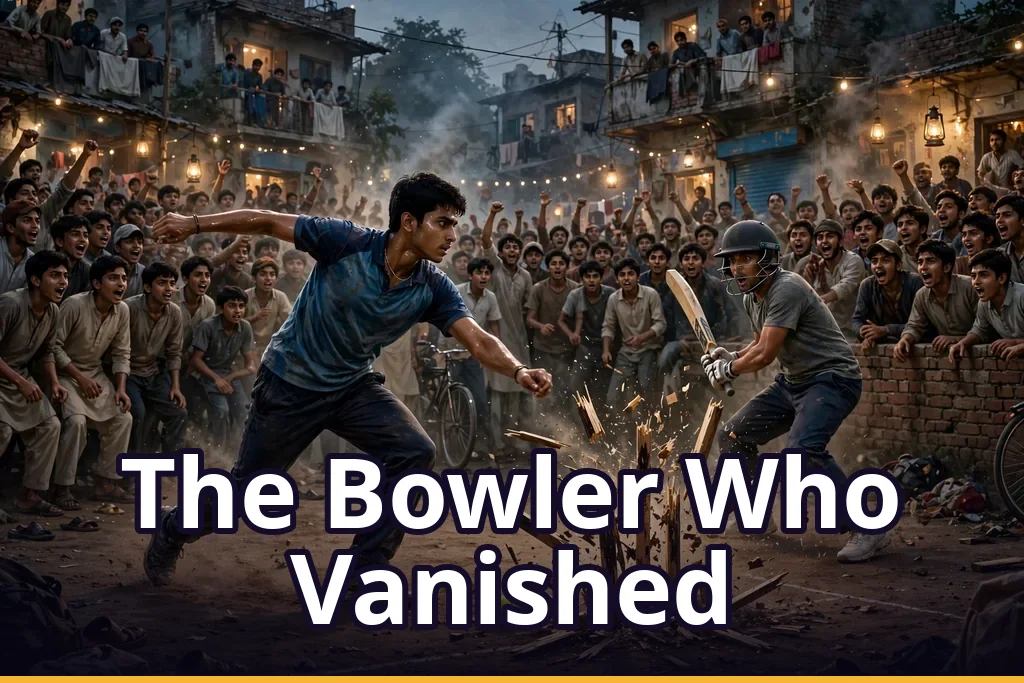
On the last ball of the semi-final, the whole mohalla poured into the ground.
The other team needed six runs off one ball. Ahmed did his usual thing — two steps back, one long look straight into the batsman's eyes, and then that yorker which, even with a taped tennis ball, could bring a batsman to his knees. Middle stump flew. The mohalla boys screamed and charged the pitch. Ahmed was lifted onto shoulders. Women clapped from the rooftops, and Chacha Rasheed tossed a tray of sweets into the air (half of them never came back to the tray, but that is another story).
The mohalla team — a team of five friends — was in the city final. For the first time ever.
That night, over tea at the hotel steps, Captain Waleed had said: "Listen, all of you. The final is on Sunday. Tomorrow, light practice only. And Ahmed —" he looked at his bowler, "— tomorrow night you sleep early. Your yorker is our trophy."
Ahmed had smiled, but the smile hadn't reached his eyes. Guddu had noticed too — the team's wicketkeeper and the fastest tongue in the mohalla — but at the time he had put it down to final-match pressure.
At eleven that night, Waleed's phone rang. It was Ahmed's mother, her voice trembling: "Beta, Ahmed hasn't come home. He left practice hours ago. His phone is off too."
By midnight, all five friends were out in the lanes. The nets ground was deserted. Master Sadiq's tailor shop — shut for two months now — sat under the same lock as always. The tea-stall man said Ahmed had come in the evening, drunk a tea, and had it put on the tab because his pockets were empty — "and yes, when he left, he stood looking towards the railway road for a very long time."
The railway road. Why would Ahmed go there?
A little before the dawn azaan, the ground's watchman called Waleed: "Sahib, something has been found near the pitch. Come and see."
At the edge of the pitch, where the morning dew glittered on the grass, sat Ahmed's kit bag.
The zip was open. Inside: his match shirt, folded. His shoes, cleaned and placed in order. The bag of taped balls — everything exactly the way Ahmed himself kept it. And on top, a folded slip of paper.
Waleed opened it with shaking hands. It was Ahmed's handwriting — the same crooked, hurried scrawl:
**"If you want to win, find me."**
Silence fell. Salman — the team's fast bowler, the hottest temper of them all — clenched his fists. "Is this a joke? What kind of joke is this before a final?!" But they all knew: Ahmed did not joke like this. Little Rizwan, who lived right next door to Ahmed's house and had been strangely quiet all night, was staring at the bag as if he knew something — and could not find the courage to say it.
At the police station, the duty officer looked at the note and yawned. "Boys this age often stay over at a friend's house. Wait twenty-four hours. And the final? The final is Sunday — he'll turn up by then."
Twenty-four hours. There were thirty-six hours left to the final.
Walking back into the ground, Guddu's eyes fell on the board by the gate, where the tournament players' names were painted. He stopped dead. "Waleed… look at this."
On the list, among their team's names, where it had said **"Ahmed — Bowler"**, the name had been scraped away with a knife. Fresh scratches. Shavings of paint still lay on the ground beneath.
Waleed picked up a curl of paint from the dirt, put the note in his pocket, and spoke quietly — the captain's hardness back in his voice:
"Ahmed didn't do this. His enemy did. Listen, everyone — we have thirty-six hours till the final. We have to find Ahmed… and we have to win the final. Both."