Episode 6
Ask the Postman
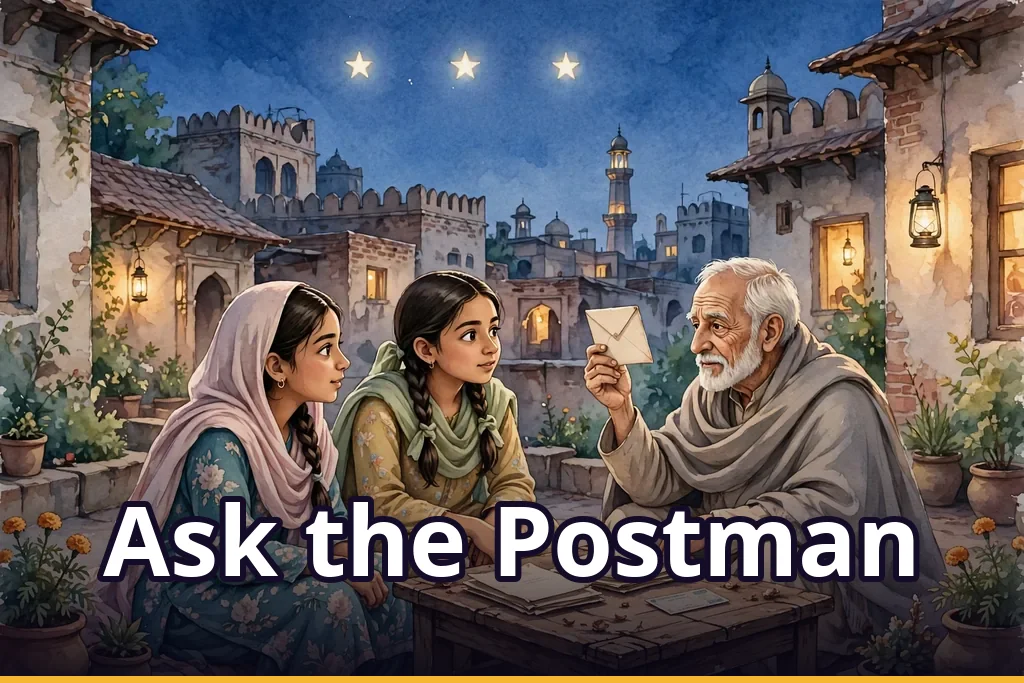
The ticket stub would not let Zara sleep.
It lay in her notebook all Saturday, small and pale, between the creases of her brother's letters — Karachi to Lahore, one seat, one passenger, three weeks ago, a Tuesday. Every time Zara opened the notebook, the stub was there, asking the same question in its quiet paper voice: he came home, and he did not come home. Why?
She tried to do her homework. She tried to read. She tried to help Ammi in the kitchen, and dropped a spoon twice, and Ammi looked at her the way mothers look when they are deciding whether to ask.
"You are somewhere else today, beta," Ammi said at last, not unkindly.
"I am here," Zara said. But she was not. She was standing in Ayaan's room again, in her mind, holding the stub up to the light, reading the date a third and a fourth time, as if the numbers might change if she looked at them hard enough.
On Sunday she took the star chart out of its drawer and spread it on her bed. The sixth drawing waited for her: Orion, the hunter, his belt three bright stars in a perfect row, his shoulders and knees marked out in fainter ones, as if the sky had drawn a tall man striding across the dark. Under it, Ayaan's note, in his steady handwriting:
"The hunter never walks alone. Ask the postman."
Zara read it five times. The hunter never walks alone. Ask the postman.
"What postman?" she whispered to the empty room. "There is only one postman I know."
And there was. Sana's grandfather — Dada Jan, the retired postman — who had carried letters through Lahore's old city for forty years, who knew every street by the shape of its doorways and every family by the handwriting on its envelopes. If anyone in the world knew what had happened to her brother's letters, it would be a man who had spent his whole life carrying other people's words.
On Monday, in the lunch break, Zara told Sana everything. She showed her the ticket stub, folded in a page of her notebook, and watched her best friend's face go through the same journey hers had: surprise, then confusion, then a slow, dawning worry.
"He came to Lahore," Sana said, very quietly, "and he did not come home?"
"Three weeks ago," Zara said. "On a Tuesday. While we were all at school and work. He was here, Sana. He was in this city. Close enough to touch. And he got on a bus and went back."
Sana was silent for a long moment, turning the stub over in her fingers as if it might have writing on the back. It did not. Only the printed words, and the date.
"Then we ask Dada Jan," Sana said at last, with the firmness she always had when a decision needed making. "Today. After school. He will know what to do with a question like this. Postmen know things, Zara. My Dada Jan says a postman is the only person in a city who knows everyone's secrets and tells no one's."
"Will he tell me?" Zara asked. "If it is Ayaan's secret?"
Sana thought about that. "He will tell you what you need to know," she said. "That is what he does."
After school they walked to Sana's house together, and Zara carried her notebook pressed against her chest the whole way, the way you carry something breakable. The stub was inside it. So were Ayaan's letters, all five of them — the long first one and the four that had grown shorter and shorter, like a voice fading down a long hallway.
Dada Jan was sitting in the courtyard in his usual chair, a glass of tea going cold beside him and a small pile of old letters on his lap. He was sorting them, slowly and carefully, the way other men sorted photographs. He looked up when the girls came in, and his face folded into its familiar smile — gentle, unhurried, a face that had learned to wait.
"Zara beta," he said. "And Sana. Sit. You look like girls carrying a question. Questions are heavy. Sit down before you drop it."
Zara sat. Her hands were shaking a little, and she was annoyed with herself for it. She was fourteen. She was not a child who shook. But her hands did not seem to know that.
"Dada Jan," she said, "I need to ask you about letters. About my brother's letters."
"Ah," he said, and set his own letters aside, giving her his whole attention in the way that only old people and good teachers know how to do. "Then ask. A question about letters is the best kind of question."
Zara opened her notebook. She laid Ayaan's letters out on the low table, one by one, in order — the first, long and full of jokes and news, and then each one shorter than the one before, the last one barely half a page, the handwriting rushed and crowded, as if written standing up. And last of all, she laid down the ticket stub.
Dada Jan picked up the letters one at a time. He did not read them — not really; his eyes moved over them the way a postman's eyes move over envelopes, taking in the shape of things rather than the words. He turned each envelope over. He looked at the postmarks. He held them up to the light, frowning slightly, and ran one bent finger along the dates.
"Karachi," he murmured. "Posted on a Monday. Arrived on a Wednesday. Posted on a Monday. Arrived on a Wednesday." He went through them all, slowly, and the courtyard was very quiet except for the sound of a neighbour's radio somewhere and the soft clink of Sana's bangles as she shifted in her chair.
Then he picked up the ticket stub.
He looked at it for a long time. Longer than Zara had expected. And something changed in his face — not surprise, exactly. Something older and quieter than surprise. Recognition.
"Three weeks ago," he said softly. "A Tuesday."
"You know?" Zara said, leaning forward. "Dada Jan — did you know he was here?"
The old postman set the stub down carefully, the way you set down something that matters. He folded his hands. He looked at Zara for a long moment, and in his eyes she saw the thing she had seen in Ammi's voice that day in the kitchen — a door held shut with one hand.
"Beta," he said, "a postman learns two things in forty years. The first is that a letter always arrives somewhere, even if it is not where it was sent. The second is that sometimes a man asks you to keep a thing for him — not because he wants to hide it, but because he is not ready for it to be found."
Zara's heart began to beat very fast.
"Dada Jan," she said. "Did my brother come to you?"
He nodded, slowly. Once.
"Three Tuesdays ago," he said. "In the evening, after the post round. He stood at my gate with a letter in his hand. Not posted. Carried. He asked me to keep it for him. And he asked me to keep any that came after it, too."
The courtyard tilted, the way the whole house had tilted the night Zara found the stub. Sana reached for her hand under the table, and Zara held on tight.
"Why?" Zara whispered. "Why would he ask you to keep his letters? Why would he not send them to me?"
Dada Jan was quiet for a moment, looking up at the sky where the first stars were beginning to show, pale against the blue of evening. High above the rooftops, three bright stars stood in a perfect row.
Orion. The hunter. Walking across the dark, and not alone.
Then the old postman looked back at her, and his voice was very quiet, and very gentle, and it carried the weight of forty years of other people's words.
"Your brother asked me to hold his letters," he said.