Episode 5
Sabz's Shield
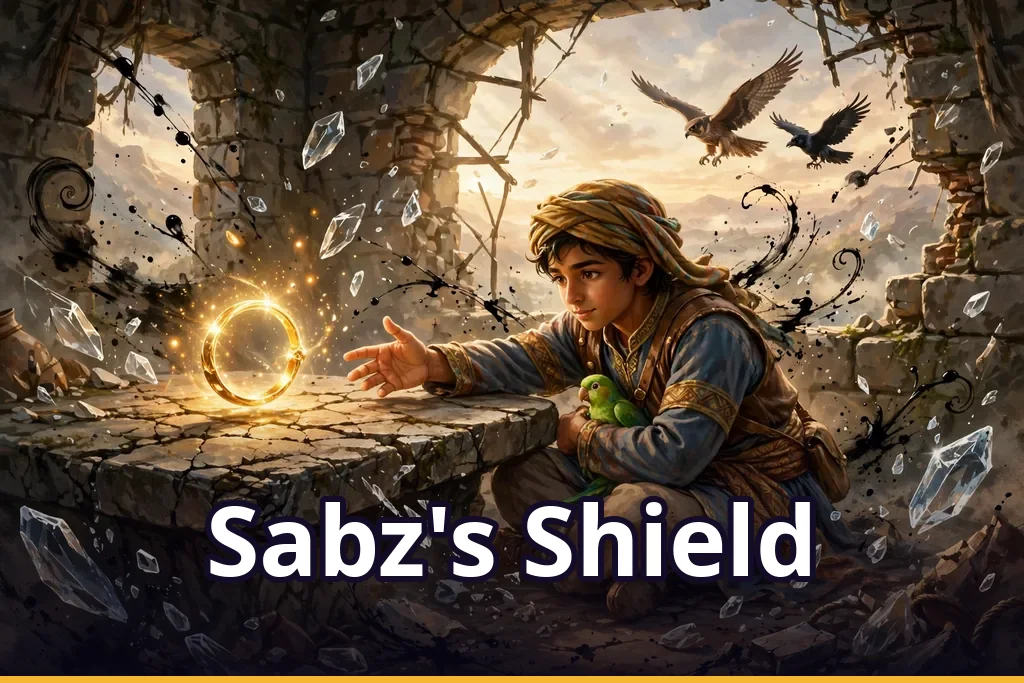
Before sunrise, the bell of the City of the Silent rang once more — this time the permitted one, light and glad. Mehran opened his eyes, and the first thing he saw was his father's sword leaning against the wall. For one heartbeat it felt as if Sardar Aman Khan — turned to stone in Zarnabad's own darbar — were watching him through those very eyes. The eyes that had once glowed with love for every caravan, before whose open dastarkhwan no hungry traveller was ever turned away.
“Abba…” Mehran whispered. “Today I bring the piece home. For you.”
He lifted the sword and pressed it to his heart. His mother's words rang in his ears: “In hardship, generosity is the greatest sword.”
“Mehran!” Sahil stood in the doorway, yawning. Sabz sat on his turban — rewarded with chickpeas for a whole night of enforced silence, the parrot was in excellent spirits. “Let's go!” Sabz announced. “Let's go! Let's go!”
Outside the baker Ustad Kareem's house, Sultan Anwaar himself was waiting for them. In his hands was a bundle — a water-skin, dates, warm bread, and a small box of ointment. “For your scorched palm,” the Sultan said, glancing at Mehran's hand. “Last night you guarded my city's honour. Now this city owes you a debt.”
He laid his hand on Mehran's head. “Hear me, my son. A heart that can keep silence can weather any storm. Go — and remember, the Sleeping Star is with the thief now. Wake it up.”
Little Gul came running and pressed a dried date into Mehran's fist. “For the road,” she said, then hid shyly behind her mother. Mehran's eyes grew wet — she reminded him of Noor, whose mischief lit up their home in Zarnabad at just that age.
“Zaar took the caravan road,” the watchman Chacha Hameed told them. “My men saw black feathers near the ruined watchtower.”
They rode out. Toofan's hooves threw up dust, and above them Shahin wheeled across the sky — then suddenly shrieked and dived toward one point. Far off, beside the caravan road, stood a ruined watchtower — half-collapsed, like an old soldier sunk to his knees. Black crows circled its broken windows.
“He's there,” Mehran said.
Inside, the stairs were broken, and every step groaned underfoot. Sahil hugged the wall. “I'm scared of heights and I'm scared of crows,” he muttered, “and today both are in the same place!”
From his turban Sabz announced: “Scared! Scared!”
“Hush, Sabz!” Sahil glared. “You're practically the enemy's spy!”
At the turn of the stairs, Zaar's voice drifted down from above — he was muttering to himself: “…the king never wastes fire… he keeps it for the stone soldiers…” Sabz cocked his head to one side and listened hard. Sahil whispered, “He hears everything and remembers everything — a dangerous combination!”
The top chamber — its door half open. And inside…
Zaar. In the shape of a man. Black coat, a honeyed smile on his lips. On a cracked stone table lay the golden arc — the Sleeping Star, softly gleaming. And beside it a small crystal vial filled with ink black as night. Zaar was tilting the vial toward the piece.
“Stop!” Mehran stood in the doorway, sword drawn.
Zaar turned — not surprised, as though he had been expecting them. “Ah, the trust-keeper's boy.” He raised the vial. “Do you know what this is? Qahhar Shah's black ink. One drop — a single drop — and this piece will forget kindness. Then the ring can never be made whole, and your father will remain stone forever.”
Mehran's heart trembled, but his feet did not move.
Zaar's smile deepened. “But I am also a merchant. Hear my offer: walk away, boy. Turn back, and your mother's house stays safe. But if you try to take this piece…” the crow-glint entered his eyes, “then Qahhar Shah will set fire to Zarnabad's granaries. Your mother, your sister — they will sleep on empty stomachs.”
Mehran's hands began to shake. His mother… Noor… Zarnabad's granaries…
And at that very moment — the worst possible moment — Sabz fluttered and squawked. But these were not his own words. They were Zaar's own words, muttered on the stairway, which Sabz had overheard:
“The king never wastes fire on granaries! Never wastes fire!”
Silence fell. Then Sahil — pressed against the wall in terror — burst out laughing despite himself. “Sabz! You've caught out his lie!”
Zaar's face flushed with rage. “Tattling bird!” he screamed, and hurled the ink vial at Sabz with all his strength.
Time stopped.
Before Mehran lay two paths — the golden piece on the table, and the vial flying through the air toward Sabz. He did not think. He flung his sword aside and threw himself over Sabz, making his own body a shield.
The vial struck his shoulder and shattered. Black ink splashed across the stone floor — a few drops stained his sleeve — but Sabz was safe, tucked beneath him.
And then… the golden arc on the table stirred.
It slid of its own accord to the table's edge — and dropped into Mehran's open hand. Warm. Throbbing. As though it knew what generosity was.
Sabz poked his head out and announced proudly: “Sabz is brave! Sabz is brave!”
Zaar screamed with fury — half man, half crow — and leapt through the window, becoming a crow. But Shahin was ready in the sky. The falcon dived, struck at his wings, and chased the shrieking Zaar into the clouds.
Mehran looked at the piece in his hand — the Sleeping Star was awake now, its glow bright. “Two pieces,” he said softly. “Two steps closer to Abba.”
From the tower's roof they looked ahead — and Sahil's breath caught. Waves of sand stretched to the horizon, like a frozen sea. The Ret ka Samandar. The Desert of Sand.
And at that moment Sabz went utterly quiet — the strangest thing of all for him. Then he whispered another fragment of Zaar's muttering that he had stored away:
“The blind beggar… knows the ring…”
Mehran looked toward the horizon — and his eyes widened. Far off, beyond the desert sea, a dust storm was rising… and its shape…
It was shaped like a crown.