Episode 9
What Zara Named
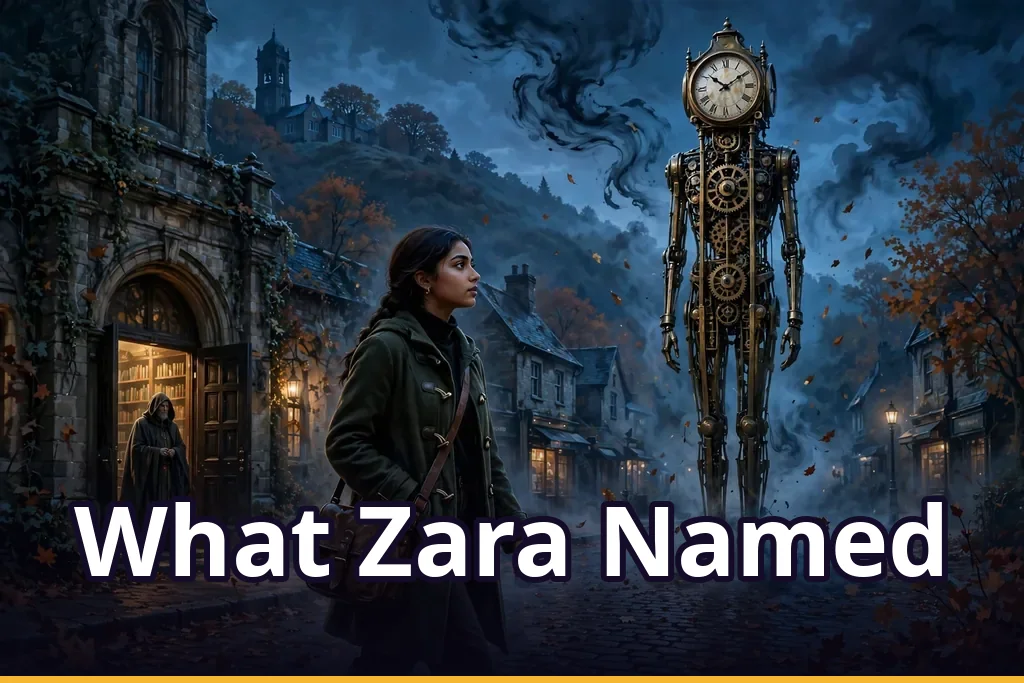
Zara Ahmed stepped toward the hour standing upright in the October air, and said, clear as a bell:
“I remember what I named.”
The school bell rang thirteen times. With every stroke the sky over Merrow Hill grew a shade darker, a shade bluer, like ink dropped into water. Across the street, the library’s door stood open. In the doorway, the Keeper’s clock-face was turned toward them, its hands no longer frozen at 11:59.
They were moving. Toward thirteen.
“Don’t go in there,” Rosa Marchetti said. Her lavender shawl had slipped from one shoulder, and for the first time since Elena had known her, the old woman looked afraid. “Once you step inside the thirteenth hour, the engine will try to write you into tomorrow. It is so hungry for material, piccola. So hungry.”
“We don’t have a choice,” Theo said. “It’s calling her.”
It was. Zara’s feet were already moving, as if the hour had tied a string around her ankles. Elena grabbed her hand. Theo grabbed the other. And the three of them stepped through the frayed edge of the hour together.
Inside was the reading room.
But wrong. The great clock on the wall showed XIII, its thirteenth hour gleaming like a wound. The books on the shelves were blank — every spine, every page, white as bone. Dust hung motionless in the air, each mote frozen mid-fall. And at the top of the forty-eight steps, the Keeper was descending.
Not gliding. Walking. Down, step by step, its clock-face tilted toward Zara.
“Zara,” Elena whispered. “What did you name? In the Naming — what did you do?”
Zara’s voice came out small. “In the seventh episode of us — the night the molten gold wrote that one of us wouldn’t come home — I panicked. The name was forming. T-H— and I thought it was Theo, and I couldn’t—” Her breath hitched. “Keepers name things, Elena. That’s what the books say. A named thing can be bargained with. A named thing has to listen. So I did what Keepers do.”
“Theo,” Elena breathed, “what did she name?”
“I named the hour,” Zara said. “The thirteenth hour. I gave it a name so it would have to listen to me instead of taking you.” She looked at the Keeper, tears running down her face. “I named it Firstday. After the frog-sticker day. Because that’s where we hid it — inside our first day of kindergarten — and I thought, if it has the name of the happiest day I know, maybe it won’t be cruel.”
The Keeper reached the bottom of the stairs. Up close, its clock-face was worse — the hands at XIII, and beneath the glass, something like eyes, turning toward Zara with terrible tenderness.
And then it spoke. Its voice was the sound of every clock in the world striking at once.
“THE NAMED HOUR MUST BE KEPT. THE ENGINE WRITES WHAT IS NAMED.”
Rosa made a small broken sound. “Oh, piccola. Oh, my brave, foolish girl.”
“What does that mean?” Theo demanded. “Kept how?”
The Keeper turned its face — slowly, like a moon turning — toward him. “A NAMED HOUR MUST BE PLACED. IT TAKES ONE HOUR FROM THE WORLD, EVERY DAY, FOREVER. THAT IS THE PRICE OF A NAME.”
Elena felt the floor tilt under her. “Tomorrow, one of the three friends will not come home,” she whispered. “The molten gold. The name forming — T-H—”
“It wasn’t Theo,” Zara said softly. “It was never Theo.”
“THE THIRTEENTH,” the Keeper said.
Silence. The dust hung. The blank books watched.
“THE NAMER KEEPS THE NAMED,” the Keeper said, and extended one long hand toward Zara. “COME, KEEPER OF THE THIRTEENTH HOUR.”
“No!” Elena threw herself between them. The brass key at her throat was burning now, hot as a coal. “There has to be another way. Rosa — the naming can be unmade, can’t it? You said spoken things can be unspoken!”
Rosa’s face was wet. “The naming can be unmade — but only by the one it was named FOR. Theo. The hour was named to save him. He must unname it. He must say: I release you.” She gripped Elena’s shoulders. “But hear me, Keeper. Unnaming costs the memory it was hidden in. The frog-sticker day. All three of you must give it up — willingly, together — or the hour keeps its keeper.”
Theo went white. “Our first day. The crackers. The crayons and rain. Elena’s untied shoelace. If we forget—”
“Then we forget each other’s beginning,” Zara finished. Her voice was steady now, the way it got when she’d already decided. “No.”
“Zara—”
“No.” She stepped around Elena, toward the waiting hand. “I named it. I keep it. That’s the rule, isn’t it? The namer keeps the named.” She looked back at them, and she was smiling, and it was the worst thing Elena had ever seen. “Take care of the library, Keeper. Don’t let it get hungry.”
“ZARA, DON’T—”
She took the Keeper’s hand.
The clock-face blazed. The hands spun — XII, XIII, XII, XIII — and the hour folded around Zara like water closing over a stone. For one heartbeat Elena saw her friend standing inside the thirteenth hour, small and straight-backed, mouthing something. Three words.
Tell it out loud.
Then the hour snapped shut, and Zara Ahmed was gone — and across the street, at the school gate where no bell should have been ringing, a bell tolled once, for a girl who would not be coming home.
Elena screamed, and the brass key seared her skin, and the Keeper turned its terrible tender face toward her —
“THE ENGINE REQUIRES ITS KEEPER’S RULING,” it said. “TOMORROW HAS A HOLE IN IT, LITTLE KEEPER. SPEAK: WHAT SHALL I WRITE?”