Episode 7
The Naming
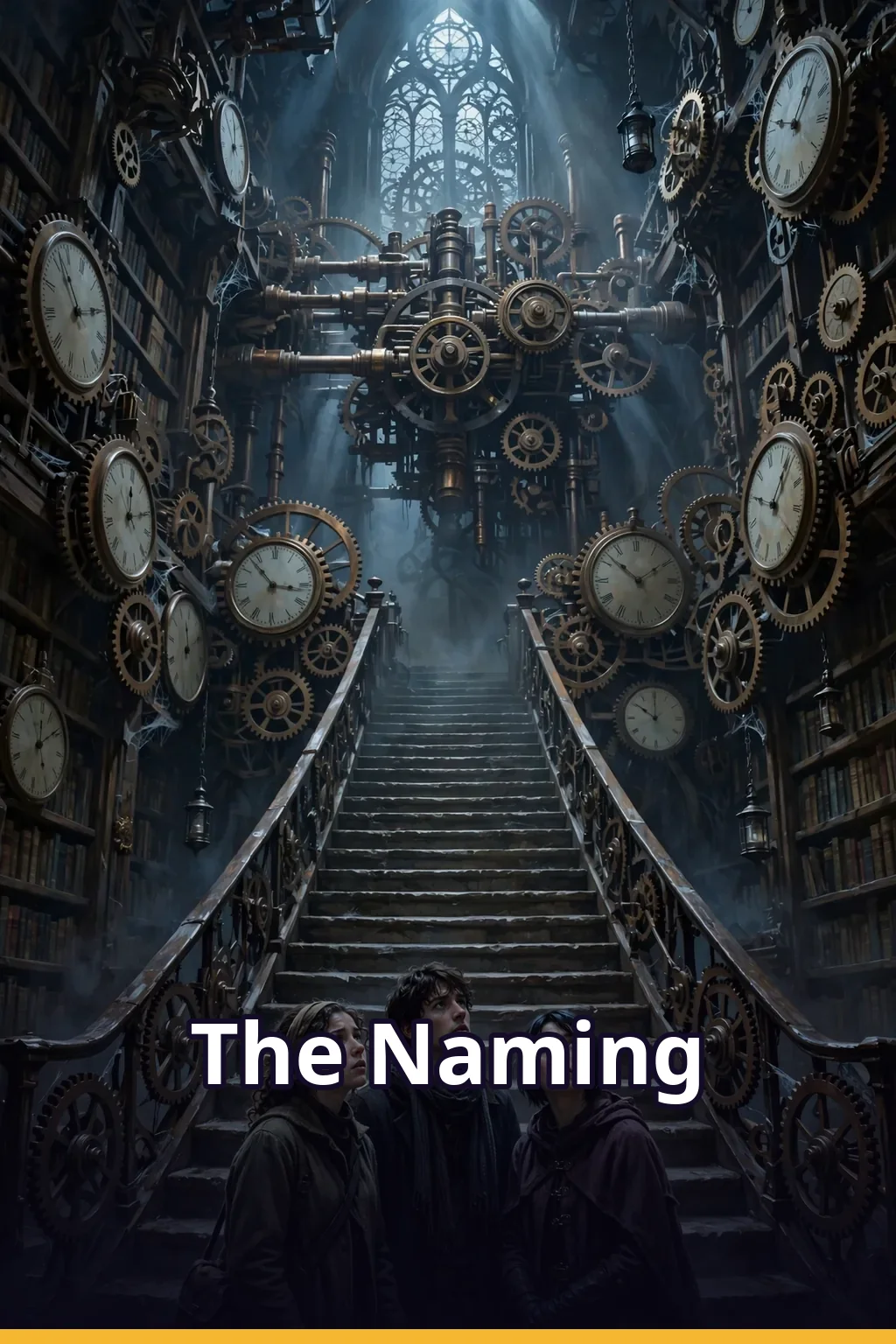
Midnight arrived in the Clockwork Library the way a held breath finally breaks — not with a chime, but with every clock stopping at once. The ticking that had lived in the walls since 1911, since Marta March first wound her engine, went silent, and the silence was louder than any bell.
We stood at the bottom of the forty-eight steps, the three of us and Rosa, ringed by shelves that leaned in like listeners. Above us the door was shut. The plaque on it read BIBLIOTHECA HOROLOGII, and beneath the Latin, the translation Marta had carved herself: All who enter leave their hours at the door.
The Keeper came down between the shelves. Its face was a clock, the hands frozen at 11:59, and in its hand the brass pen glowed faintly, already warm. My fingers found the key at my throat — TEMPVS ED AX RERVM, time is the queen of things — and held on.
"ZARA AHMED," the Keeper said, in the voice of every hour striking at once. "THIRD KEEPER. NAME YOUR PRICE."
Zara's hand found mine. Her palm was sweating. For all her drama-club fierceness, for every stage she had ever owned, she had never been this scared — and she wasn't hiding it, which somehow made her braver.
Rosa stepped close, her shawl smelling of lavender and old paper, and murmured the rule she had taught us in the kitchen above, over tea gone cold: "Name your price before the Rewriting names it for you, piccola. What is named first is chosen. What is chosen is yours to give."
But we had something the engine hadn't advertised. We had the dodge.
A memory spoken aloud to someone who loves you is too heavy for the brass pen to lift. The library can only take what belongs to the Keeper alone.
Zara lifted her chin. "I name my price," she said, and her voice rang off the shelves. "And I name it OUT LOUD."
"Zara," Theo whispered, "the script—"
"There is no script," Zara said. "That's the point."
She turned to me, to Theo, and she told it. All of it. The first day of kindergarten — the day the two of them had paid and forgotten, the day only she still carried, because she had been there too, watching from the doorway with her mother's hand on her shoulder. She told it the way you tell a story you refuse to let die: the frog sticker peeling at one corner of Theo's cubby, the crackers I shared because he was crying, the teacher saying "new friends" like it was a spell. She told it in color and smell and sound, until it wasn't a memory anymore. It was a room, and we were all standing in it.
"That day is the most precious thing I own," Zara said, "because it isn't mine. It's ours. I name it. The frog-sticker day. Take it if you can."
The brass pen descended. It hovered over the ledger. It trembled — I saw it tremble — and it could not lift. The memory was too heavy now, held up by three pairs of hands.
A sound went through the shelves like wind through a wheat field. The Keeper's clock-face tilted, the frozen hands shivering at 11:59.
"A TRUE NAMING," the Keeper said. "AND A PRICE UNLIFTABLE."
For one bright second, I thought we had won.
Then the Keeper said: "THE ENGINE HAS FINISHED SHOPPING. THE ENGINE WILL NOW NAME ITS OWN."
Rosa went white. "No—" she breathed. "Piccola, no—"
I remembered, too late, the line I had found in Marta's ledger that afternoon, in the margin of a page about the Rewriting, in ink so faded I had nearly missed it: What is taken in place of a price is taken from the namer only.
The dodge had a price of its own. Of course it did. The library always collects.
The brass pen came down on Zara — not on the shared day, which it could not lift, but on the one thing in that room that belonged to Zara Ahmed alone: the memory of this midnight. The memory of standing here, unafraid, telling the story. The memory of the naming itself.
"Zara!" I shouted, and Theo lunged, but the pen was faster than grief. It drank the hour from her like ink from a well.
Zara blinked. She looked at the Keeper, at the ledger, at us. "Did—" she said. "Did I already name it? What did I name?"
She didn't remember. The bravest thing she had ever done was gone from her — kept now only in me and Theo, too heavy for the pen to ever lift again.
Rosa caught her before her knees gave. "You were magnificent," Rosa whispered fiercely, all the old Italian warmth cracking through. "Even if you cannot keep it, piccola. I will keep it for you."
But the Rewriting was not finished. And Marta's other secret — the one I had read in her ledger and wished I hadn't — began to do its work.
The engine doesn't write tomorrows from nothing. It writes them from taken yesterdays. Every tomorrow is stitched from somebody's paid past.
The great gears woke. Pages turned themselves in the ledger. And across the page, in molten gold, tomorrow began to write.
I read it over the Keeper's shoulder, and my blood went cold.
"TOMORROW," it wrote, "ELENA MARCH WILL WAKE IN HER BED ON MERROW HILL. SHE WILL EAT BREAKFAST. SHE WILL WALK TO SCHOOL. SHE WILL NOT REMEMBER THE LIBRARY. SHE WILL NOT REMEMBER THE FORTY-EIGHT STEPS. SHE WILL NOT REMEMBER THEO. SHE WILL NOT REMEMBER ZARA."
"No," Theo said. All his dry humor was gone; his voice was a boy's voice, stripped bare. "No — we paid the kindergarten day, not—"
"TOMORROW," the gold went on, merciless, "ELENA WILL MEET A BOY WITH A FROG STICKER ON HIS CUBBY. IT WILL BE THE FIRST DAY OF KINDERGARTEN. IT WILL BE THE FIRST TIME THEY HAVE EVER MET."
The paid yesterday, stitched into tomorrow. The engine had taken their first meeting and was sewing it back into the future — as strangers.
The writing stopped. Midnight released us. The clocks began to tick again, all at once, like a heart restarting.
We climbed the forty-eight steps in silence. At the top, beneath the plaque, the door swung shut behind us with a sound like a book closing.
On the sidewalk, under the streetlamp, Zara stopped. She pressed her hands to her temples. "There's an hour missing," she whispered. "I can feel the edges of it. Tell me what I did. Please — I can feel that it mattered, and I don't get to keep it."
"I'll tell you," I said, and my voice broke. "I'll tell you every day, as many times as it takes. It'll be ours. They can't take ours."
Behind us, in the dark of the closed library, every clock struck one — except one, which struck thirteen, and kept striking, counting up toward a tomorrow in which we had never met.