Episode 1
The Night the Lift Went to 1972
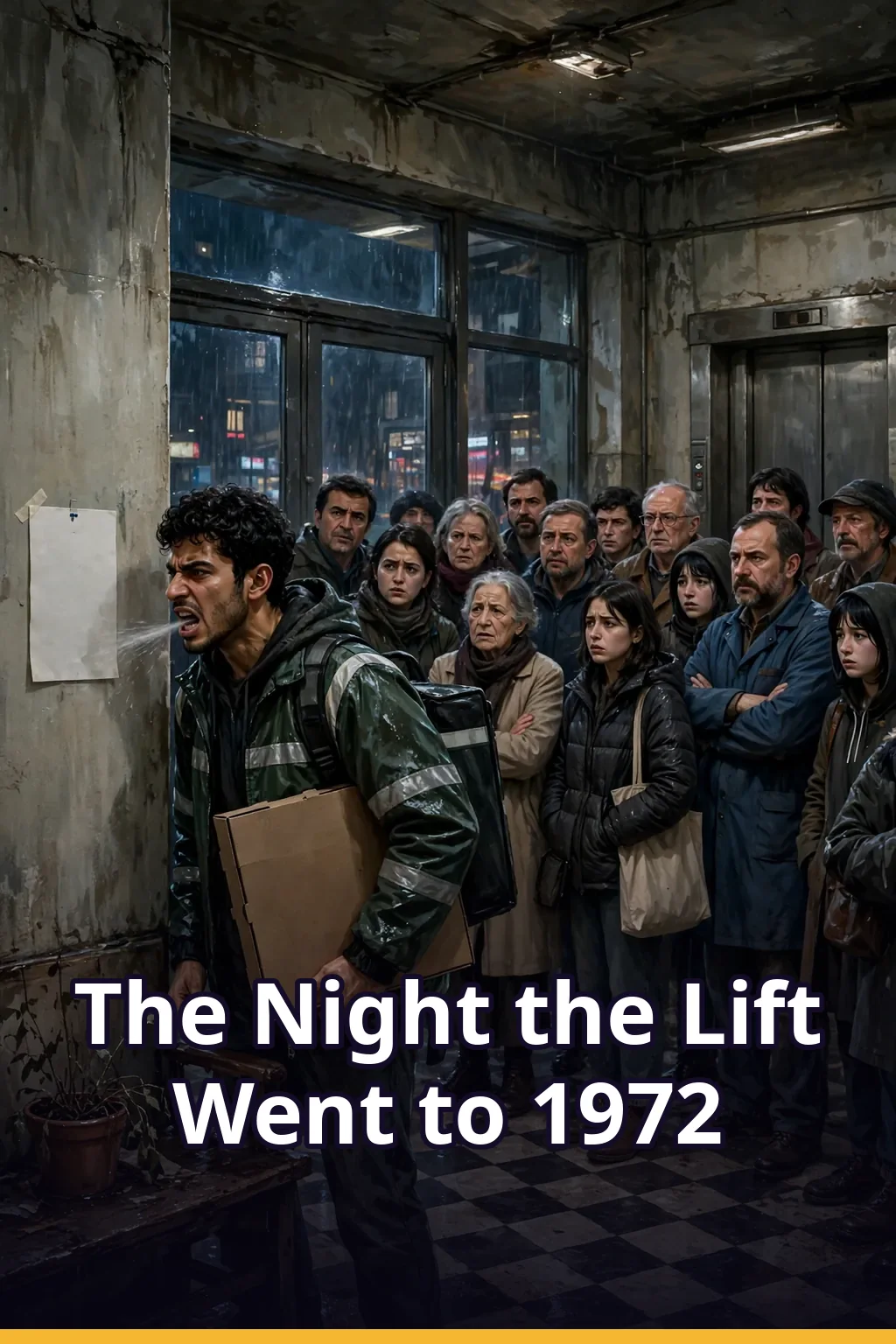
The notice was pasted on the lobby wall by noon, and by one o'clock half of Marina Heights was standing in front of it.
"…residents are informed that this structure will be demolished in thirty (30) days. Vertex Developers regrets any inconvenience."
"Regrets!" Omar spat, still in his delivery-rider jacket, a pizza box under one arm that nobody had ordered. "Thirty days to regret our whole lives, uncle? Wah."
Maha Siddiqui stood a little apart from the crowd, hugging her sketchbook. She had drawn Marina Heights a hundred times — its sea-facing balconies, its weather-stained concrete, the old brass-gated lift that groaned like a grandfather clearing his throat. She was twenty-two, in her final year of architecture studies, and as far as she was concerned the notice on the wall was not about a building. Twenty-four floors. Ninety-six families. It was about her whole world.
"They can't just do this," she said. "This building was a hotel first. It has history. My Dadi worked here in 1972!"
"Beta," said Rafiq Chacha, the liftman, locking the lift gate for the afternoon with the tenderness of a man tucking in a child, "history doesn't pay developers." He had run this lift for forty years. He knew every resident, every cough of the machinery, and — though he never said it — rather more about this lift than anyone alive.
Up on floor nine, Dadi Sakeena set down two cups of chai and looked at the notice Maha had photographed. For a long moment the old lady said nothing. "Hotel Marina," she murmured at last. "You should have seen its opening night. Chandelier like a frozen fountain. I was twenty, behind the reception desk, terrified of the telephone." Her eyes went somewhere far away. "This tower has seen everything, Maha. Everything."
The storm came that night like it had a grudge. Rain hammered the sea-facing windows; the whole tower swayed its old bones; and the lights began their monsoon flickering — off, on, off, on.
At 11:40, with the power out for the third time, Maha, Omar and Tara — Tara D'Souza from floor three, whose father supervised building security and who filmed everything on principle — squeezed into the lift to go down to the lobby, where someone's generator at least promised light.
Rafiq Chacha was off duty. The lift descended on its own ancient logic: nine… eight… seven…
At the lobby, it did not stop.
It kept going down — slowly, politely, impossibly — past the ground floor of a building that has no basement. Omar stopped joking. Tara stopped filming, then remembered herself and filmed harder. The floor indicator's needle sank below zero and trembled at a symbol none of them had ever seen on it: a small brass **0**.
The gates opened.
They were looking at the same lobby — and not the same lobby at all. The marble was new and shining. A chandelier poured light like a frozen fountain. A swing band played in a corner. Men in wide ties and women in bright saris moved across the floor beneath a painted banner:
**HOTEL MARINA — GRAND OPENING — 1972**
"Okay," Omar whispered. "Okay. I have finally lost my mind. It was a good mind."
Behind the reception desk stood a young woman with a flower tucked in her braid, wrestling with a Bakelite telephone and laughing at something a bellboy had said. Maha's breath stopped in her chest. She knew that face. She had seen it in a black-and-white photograph on her own living-room wall, every day of her life.
It was Dadi. Twenty years old. Young Sakeena.
Maha stepped out of the lift as if pulled. The young woman looked up — and frowned slightly at Maha's strange clothes, her stranger face that was somehow familiar. "Miss? Are you lost? You dropped this—" and she pressed something into Maha's hand: a heavy brass key on a leather tag.
That was when the lobby clock chimed — a small brass bell, sweet and final — and from far away, as if through water, they heard the lift's warning groan.
"Maha! DOORS!" Tara screamed.
They ran. The gates were already sliding. Omar threw his shoulder in, Tara dragged Maha by the sketchbook strap, and the three of them tumbled inside as the lift sighed shut — and the world blinked: flicker, darkness, flicker —
— and the gates opened on their own dim lobby. Peeling paint. The demolition notice. The smell of rain and old concrete. The indicator needle sat innocently at **G**.
Nobody spoke for a full minute.
Then Maha opened her fist. In her palm lay the brass key, warm as if someone had just been holding it. The leather tag was stamped in faded gold letters:
**MASTER KEY — H. D'MELLO, PROPRIETOR**
She took it upstairs with shaking hands and held it out to her grandmother.
Dadi Sakeena looked at the key — and every drop of colour left her face.
"Where did you get this?" she whispered. "Maha… where did you get this? This key was lost. It was lost in 1972."